

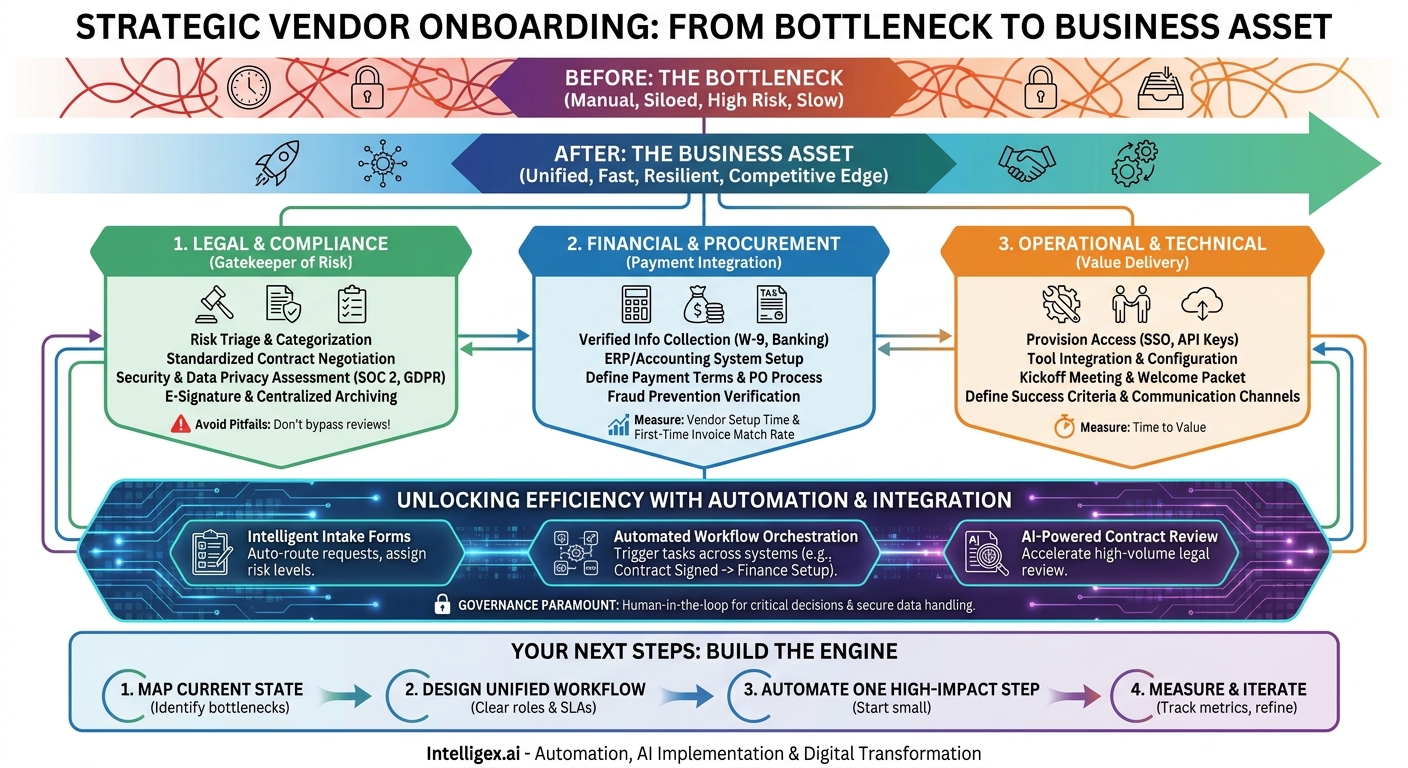
Vendor onboarding is often seen as a bureaucratic chore, a necessary evil managed through a chaotic mix of spreadsheets, email chains, and whispered requests across departments. But this seemingly simple administrative process is a powerful strategic lever. Getting it wrong means delayed projects, frustrated teams, and unnecessary risk. Getting it right unlocks speed, resilience, and a competitive edge. A slow, manual process for onboarding a new marketing technology partner can delay a critical campaign by weeks. A missed security check on a software provider can expose sensitive company data. These aren’t just operational hiccups; they are significant business liabilities.
The core challenge is that effective vendor onboarding is not one department’s job. It’s a cross-functional relay race involving Legal, Finance, IT, Security, and the operational team that needs the vendor’s service. When these teams operate in silos, the baton gets dropped. The result is a process that is slow, opaque, and inconsistent, creating a poor experience for both your internal teams and your new partners. The key to transformation is to stop treating onboarding as a series of disconnected tasks and start designing it as a single, unified business process.
Deconstructing the Onboarding Maze: Three Core Pillars
A robust vendor onboarding framework rests on three distinct but interconnected pillars. While they are presented here sequentially, in a well-designed system, many of these activities should run in parallel to maximize efficiency. Thinking about them as separate workstreams helps clarify ownership and requirements at each stage.
- Legal and Compliance: This is the gatekeeper of risk. This pillar covers everything from contract negotiation and signature to ensuring the vendor meets your company’s security, data privacy, and regulatory standards. It’s about protecting the organization from legal and reputational harm.
- Financial and Procurement: This is where the vendor is officially integrated into your financial systems. It involves collecting tax and banking information, setting up payment terms, and creating a vendor profile in your accounting or Enterprise Resource Planning (ERP) system so that purchase orders can be issued and invoices can be paid accurately and on time.
- Operational and Technical: This is the final and most critical pillar for value delivery. It involves everything required for your team to actually use the vendor’s product or service. This can range from provisioning software licenses and API keys to granting building access or scheduling kickoff meetings.
Without a clear process that addresses all three pillars, you create bottlenecks. A vendor might be legally cleared to work but can’t get paid because Finance is still waiting on a tax form. Or, a new software is fully paid for but sits unused because IT hasn’t provisioned the necessary system access for the team.
Navigating the Legal and Compliance Gauntlet
The legal and compliance stage is often the most time-consuming and fraught with potential delays. Its goal is simple: ensure any new partnership is structured to protect your company’s interests. A standardized, risk-based approach is essential to prevent this stage from becoming a black hole where vendor requests disappear for weeks.
A structured legal review process moves a vendor from initial vetting to a fully executed agreement. The level of scrutiny should directly correlate with the level of risk the vendor introduces.
- Initial Risk Triage: The first step is to categorize the vendor. Not all vendors are created equal. A freelance graphic designer who never touches customer data requires a different level of review than a cloud platform that will process your entire customer database. Create simple tiers (e.g., Low, Medium, High Risk) based on factors like data access, strategic importance, and contract value. This allows you to fast-track low-risk vendors with standard, non-negotiable agreements.
- Contract Review and Negotiation: For medium and high-risk vendors, the contract review begins. Start with your company’s standard templates. This provides a consistent baseline and reduces negotiation cycles. The legal team should focus its redlining efforts on key areas: limitation of liability, data ownership, security obligations, and termination clauses. The goal isn’t to win every point but to achieve a fair agreement that mitigates critical risks.
- Security and Data Privacy Assessment: This step is non-negotiable for any vendor that will handle sensitive company or customer data. It typically involves a standardized security questionnaire. You should also request and validate relevant certifications, such as SOC 2 reports or ISO 27001 certification. For vendors processing personal data of EU citizens, you must ensure a Data Processing Addendum (DPA) is in place that complies with the General Data Protection Regulation (GDPR). This review should be conducted by your IT Security or Compliance team.
- Final Signature and Archiving: Once all terms are agreed upon, the contract moves to signature. Using e-signature platforms like DocuSign or Adobe Sign dramatically accelerates this final step. The executed agreement must then be stored in a centralized contract repository, not someone’s email inbox, where it can be easily accessed for renewals, audits, or future reference.
Common Pitfalls to Avoid
Be wary of teams trying to bypass the process for the sake of speed. Skipping a security review for a “small” marketing analytics tool can still lead to a data breach. Using an old contract template found on a shared drive can expose the company to outdated legal terms. A consistent process is your best defense against these unforced errors.
Financial Onboarding: Ensuring Smooth and Accurate Payments
Once a vendor is legally approved, the finance and procurement teams step in to make them an official, payable entity in your systems. This process is all about accuracy and compliance. Errors here lead to delayed payments, which can damage vendor relationships and even disrupt service delivery. It can also create serious tax and audit issues down the line.
A well-defined financial onboarding workflow ensures all necessary information is collected securely and entered correctly from the start. This prevents the all-too-common scenario of a frantic scramble for banking details when the first invoice is due.
Essential Financial Onboarding Checklist
Before a vendor can be paid, your finance team needs a complete and verified information packet. A centralized portal or secure form is the best way to collect this, as emailing sensitive information like bank account numbers is a significant security risk. Your checklist should include:
- Correct Legal Entity Name and Address: This must match the name on the contract and invoices.
- Tax Identification Information: For U.S. vendors, this is a W-9 form. For international vendors, it’s typically a W-8BEN or W-8BEN-E form. Collecting this upfront is critical for tax compliance.
- Banking Details: This includes the bank name, address, account number, and any relevant routing numbers (e.g., ABA for the U.S., IBAN/SWIFT for international payments). This information should be subject to a verification process to prevent fraud.
- Primary Invoicing Contact: A dedicated email address for submitting invoices (e.g., [email protected]) and the name of the primary finance contact at the vendor’s organization.
- Purchase Order (PO) Requirements: Clarify if the vendor requires a PO on all invoices and communicate your company’s PO process to them.
What to Measure
To gauge the efficiency of your financial onboarding, track key metrics like Vendor Setup Time (from request to active in the payment system) and First-Time Invoice Match Rate (the percentage of a new vendor’s first invoices that are processed without errors or exceptions). A high match rate indicates you are collecting the right information and setting clear expectations from the beginning.
Operational Integration: From Contract to Value
This is where the true value of the new partnership is realized. The operational onboarding phase is about equipping the vendor and your internal team with the access, tools, and information they need to start working together effectively. This stage looks very different depending on the vendor and the department they are serving.
Consider these scenarios:
- For IT onboarding a new SaaS provider: The team needs to configure single sign-on (SSO), provision licenses to the correct employees, and integrate the tool’s API with other systems, like your CRM. The vendor needs API keys and access to a sandbox environment for testing.
- For Marketing onboarding a new creative agency: The marketing team needs to provide the agency with access to the brand asset library, project management software, and key internal stakeholders. The agency needs to understand the creative brief process and project review cycles.
- For Supply Chain onboarding a new materials supplier: The operations team needs to set the supplier up in the inventory management system, establish delivery protocols, and provide access to the supplier portal for order tracking. The supplier needs clear specifications and quality control standards.
A successful operational handoff requires a clear “welcome packet” or kickoff meeting. This sets expectations on communication channels (e.g., Slack, email, weekly calls), key points of contact on both sides, and the criteria for success. The goal is to minimize the ramp-up time so the vendor can start delivering the service you hired them for as quickly as possible.
What to Measure
The ultimate metric here is Time to Value. How many days pass between the contract being signed and the vendor delivering their first successful outcome? This could be the launch of the first campaign by an agency, the first successful data sync from a new software, or the first on-time delivery from a new supplier. Reducing this time is a direct result of a streamlined onboarding process.
Unlocking Efficiency with Automation and Integration
Manually managing the handoffs between Legal, Finance, and Operations is where most onboarding processes break down. This is where modern integration and automation tools can provide immense value, creating a connected, transparent, and scalable system. This is not about replacing human judgment but about automating the administrative work so your teams can focus on higher-value activities like risk assessment and strategic relationship management.
Here are practical ways to apply automation:
- Intelligent Intake Forms: Instead of a generic “new vendor request” email, use a smart form that asks initial triage questions. Based on the answers, it can automatically route the request to the right people, assign a risk level, and use a pre-approved template for low-risk engagements.
- Automated Workflow Orchestration: Use an integration platform to connect your systems. For example, once a contract is signed in DocuSign, a workflow can automatically trigger a task in your finance team’s project management tool to begin the financial setup. When Finance marks the vendor as “active,” another workflow can notify the business owner that they can begin operational onboarding.
- AI-Powered Contract Review: For high-volume contracts, AI tools can accelerate the legal review process. These tools can scan a vendor’s proposed agreement and flag non-standard clauses or risky language that deviates from your company’s playbook. This allows the legal team to focus their attention where it’s needed most. It doesn’t replace a lawyer, but it makes them dramatically more efficient. For more on the importance of standards in security documentation, the AICPA provides extensive resources on frameworks like SOC 2.
A Note on Data and Security
As you introduce automation, especially solutions involving AI or sensitive vendor data, governance is paramount. An automated system must have robust guardrails. Access to the vendor master file, which contains sensitive banking and tax information, should be strictly controlled and logged. When using AI for risk analysis, ensure there is always a “human in the loop” to review and approve critical decisions. The goal of automation is to assist, not abdicate, human oversight. Finally, always use secure, encrypted channels for collecting vendor data. A dedicated vendor portal is infinitely more secure than back-and-forth emails.
Your Next Steps: Building a Better Onboarding Engine
Transforming your vendor onboarding process from a chaotic liability into a strategic asset doesn’t require a massive, multi-year project. It starts with a commitment to cross-functional collaboration and a focus on incremental improvements. A clear, efficient, and transparent onboarding process sends a powerful message to new partners: that you are professional, organized, and easy to do business with. That first impression can set the tone for the entire relationship.
Here is a simple plan to get started:
- Map Your Current State: Get representatives from Legal, Finance, IT, and a key business unit in a room. Whiteboard your current vendor onboarding process from initial request to first payment. Be honest about the bottlenecks, handoffs, and points of friction.
- Design a Unified Workflow: Based on your map, design a streamlined future-state process. Define clear roles and responsibilities. Create standard templates for contracts and communications. Agree on service level agreements (SLAs) for each stage.
- Automate One High-Impact Step: Don’t try to automate everything at once. Pick one major pain point, like the initial collection of vendor information, and solve it with a smart form or a simple workflow. A small win builds momentum.
- Measure and Iterate: Define the key metrics that matter to your business, such as “Time to Onboard” and “Time to Value.” Track them consistently. Use the data to identify the next bottleneck and continue to refine your process.
Your Next Read:
Category:
Get a FREE
Proof of Concept
& Consultation
No Cost, No Commitment!