

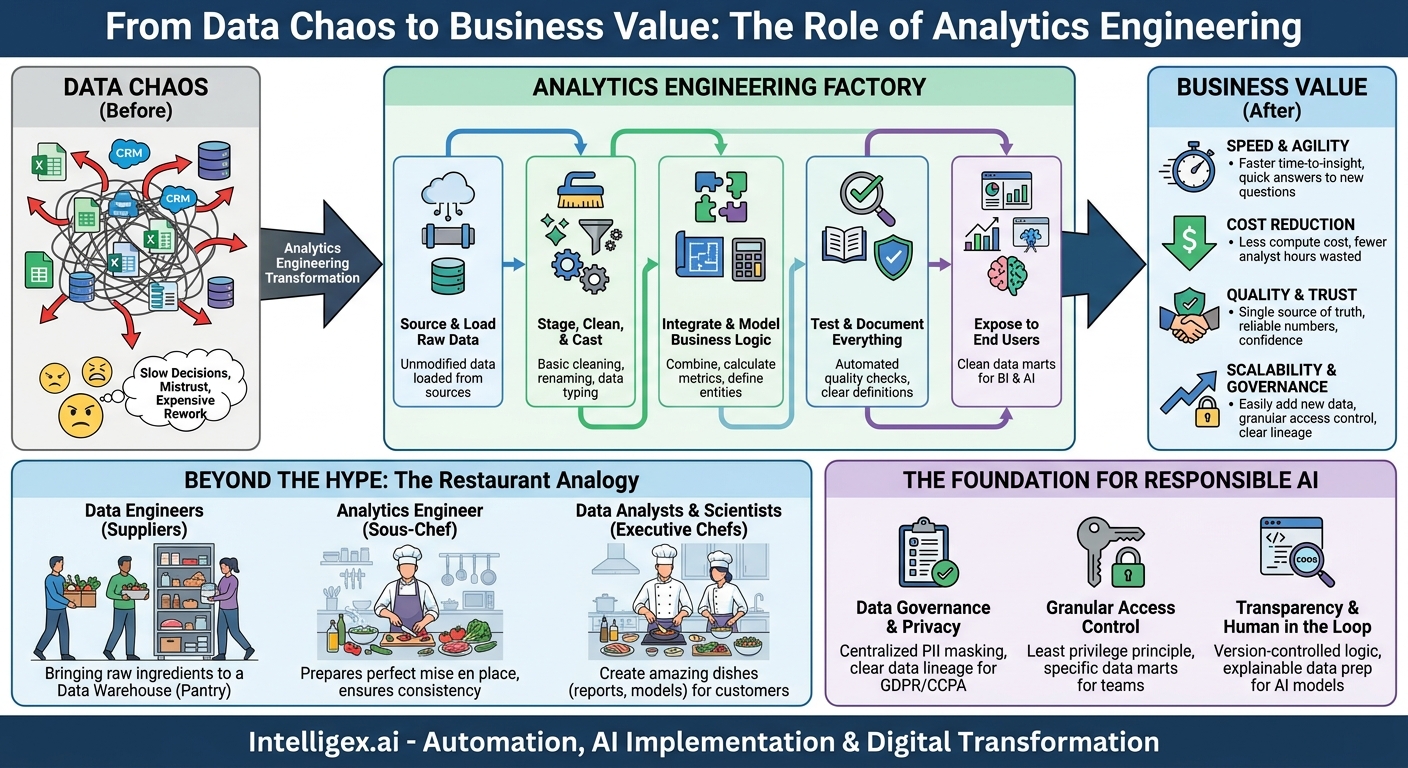
Your teams are drowning in data, yet starving for wisdom. Reports from sales and finance show different revenue numbers, marketing struggles to calculate customer lifetime value, and your data analysts spend 80% of their time just cleaning data instead of finding insights. The result is slow decisions, expensive rework, and a deep-seated mistrust in the very data that’s supposed to guide your business forward. This isn’t a failure of your people or your tools. It’s a failure of the process that connects raw data to business value.
This is the problem that analytics engineering solves. It’s not just another buzzword or a niche technical role. It’s a disciplined practice that transforms your chaotic data pipelines into a reliable, scalable factory for producing trusted insights. By applying software engineering principles to the world of analytics, it creates a stable foundation that allows you to move faster, reduce costs, and finally make decisions with confidence.
Beyond the Hype: What Is Analytics Engineering, Really?
Imagine your data pipeline is a professional restaurant kitchen. Your Data Engineers are the suppliers. They are experts at building the infrastructure to deliver raw ingredients (data) from various sources like your CRM, ERP, and marketing platforms into the kitchen’s pantry (your data warehouse). Your Data Analysts and Scientists are the executive chefs. They take prepared ingredients and create amazing dishes (reports, dashboards, and AI models) that delight the customers (your business stakeholders).
So, who is doing the critical work in between? Who washes the vegetables, butchers the meat, and prepares the perfect mise en place so the chefs can work their magic efficiently and consistently? That’s the Analytics Engineer.
An analytics engineer works inside the data warehouse, taking the raw data delivered by data engineers and transforming it into clean, reliable, and easy-to-use datasets. They don’t just write one-off queries. They build a logical, well-documented, and tested data architecture that serves as the “single source of truth” for the entire organization. Their work ensures that when a chef needs “diced onions,” they get perfectly uniform, high-quality diced onions every single time, without having to chop them from scratch.
Key Activities and Tools
The core of the analytics engineering workflow revolves around a few key activities:
- Data Modeling: Structuring raw data to reflect business concepts. Instead of a messy table of all transactions, they create a clean `fct_orders` table and a reusable `dim_customers` table.
- Transformation: Writing clean, modular, and version-controlled SQL code to perform these modeling tasks.
- Testing: Automatically validating data to ensure its accuracy. For example, a test might check that an `order_total` is never negative or that every order has a valid customer ID.
- Documentation: Clearly defining what each data field means, where it came from, and how it was calculated. This builds trust and makes data self-service a reality.
This modern workflow is powered by tools that bring software engineering best practices to SQL. The most prominent tool in this space is dbt (data build tool), which runs on top of a cloud data warehouse like Snowflake, Google BigQuery, or Amazon Redshift. This combination allows teams to build, test, and deploy data models with the same rigor as a software development team.
The Business Value You Can Actually Measure
Adopting analytics engineering isn’t just a technical upgrade. It delivers tangible business outcomes that you can track and measure across four key areas.
1. Speed and Agility
When your data is a tangled mess, every new question requires a heroic effort from an analyst to untangle it. With a well-modeled data foundation, analysts can answer complex questions in hours, not weeks.
Scenario: The marketing team wants to understand the impact of a recent campaign on sales in a specific customer segment.
Without Analytics Engineering: An analyst spends days joining raw data from Google Ads, Salesforce, and your payment processor, painstakingly cleaning the data and trying to align customer definitions.
With Analytics Engineering: The analyst uses a pre-built, trusted `customer_attribution` model. They simply join it with the campaign data and have a reliable answer by the end of the day.
What to measure: Track the “Time to Insight,” which is the average time it takes from a business question being asked to a data-backed answer being delivered.
2. Cost Reduction
Inefficiency is expensive. It burns through your most valuable resources: your team’s time and your cloud computing budget. Analytics engineering tackles both.
Scenario: Three different analysts are asked to report on monthly recurring revenue (MRR). Each one writes their own complex query, duplicating effort and potentially arriving at different numbers.
Without Analytics Engineering: You pay for three analysts to do the same work, and you pay for the cloud warehouse to run three separate, complex queries.
With Analytics Engineering: A single, efficient, and tested `monthly_recurring_revenue` model is built once. The analysts simply query this small, aggregated table. It saves hours of analyst time and significantly reduces computational costs.
What to measure: Analyst hours saved on data preparation tasks; reduction in monthly data warehouse compute costs.
3. Quality and Trust
Mistrust in data paralyzes an organization. When leaders can’t rely on the numbers, they revert to gut feelings, and arguments erupt over whose dashboard is “correct.” Analytics engineering establishes a single source of truth that everyone can depend on.
Scenario: The finance team’s revenue report for Q2 doesn’t match the one from the sales operations team.
Without Analytics Engineering: A week is lost as both teams try to reconcile their different data sources and business logic, eroding trust between departments.
With Analytics Engineering: Both teams pull from the same certified `fct_revenue` table in the data warehouse. The logic for calculating revenue is documented, tested, and approved by all stakeholders. The numbers always match.
What to measure: Reduction in data-related support tickets; qualitative feedback from stakeholders on their confidence in dashboards and reports.
4. Scalability and Governance
As your company grows, adds new products, or enters new markets, your data complexity explodes. A traditional, ad-hoc approach to analytics breaks under this strain. The structured, code-based approach of analytics engineering is built to scale.
Scenario: Your company acquires a smaller firm with a completely different CRM system.
Without Analytics Engineering: Integrating the new data is a massive, manual project that could take months, and the new data remains siloed.
With Analytics Engineering: You can create a new set of transformation models to map the acquired company’s data to your established, centralized `dim_customers` and `fct_sales` tables. The integration is faster, and the new data becomes part of the trusted core from day one.
What to measure: Time required to integrate a new data source; ability to maintain data quality metrics as data volume grows.
Who Needs an Analytics Engineer? A Quick Gut Check
Not every organization is ready for a dedicated analytics engineer, but many are feeling the pain that the role is designed to solve. If you find your team nodding along to several points on this checklist, it’s a strong signal that you need to invest in this capability.
- Do different teams frequently argue about which report is the “source of truth”?
- Does it take more than a few days to get a data-backed answer to a new business question?
- Are your data analysts spending more time preparing and cleaning data than analyzing it?
- Is your data warehouse a “data swamp” filled with hundreds of tables that no one understands or trusts?
- Do you hesitate to build AI or machine learning models because you don’t trust the quality of the underlying data?
- When someone leaves the data team, do you lose critical knowledge about how key metrics are calculated?
- Does making a small change to a core data pipeline feel risky and difficult?
Answering “yes” to even two or three of these questions indicates that your organization is suffering from data debt, and the principles of analytics engineering are the most effective way to start paying it down.
The Core Workflow: From Raw Data to Trusted Insight
To make this tangible, let’s walk through the standardized process an analytics engineer follows to create a reliable dataset. This disciplined, multi-stage approach is what separates analytics engineering from writing ad-hoc queries.
- Source and Load Raw Data: The process begins in the data warehouse, where raw, untouched data has been loaded by a data engineer. This might be a direct copy of a production database table like `salesforce.opportunity` or raw event data like `segment.page_views`. This raw data is never modified.
- Stage, Clean, and Cast: The analytics engineer creates “staging” models. These models perform basic cleaning on the raw data. They select only the necessary columns, rename them to be clear and consistent (e.g., `opportunity_id` instead of `Id`), cast data types correctly (e.g., converting a text string to a proper date), and perform very light transformations. The goal here is to create a clean, one-to-one reflection of the source system.
- Integrate and Model Business Logic: This is the heart of the work. The analytics engineer combines multiple staging models to create robust, reusable “intermediate” or “marts” tables that reflect core business entities and processes. For example, they might join the `stg_salesforce_opportunity` model with `stg_stripe_invoices` to create a `fct_sales_transactions` table that contains a complete view of a sale. This is where critical business logic, like calculating MRR or defining an “active user,” is encoded in SQL.
- Test and Document Everything: As these models are built, they are wrapped in tests. Automated tests check for uniqueness (e.g., every `order_id` is unique), non-null values (e.g., every order has a `customer_id`), and referential integrity (e.g., every `customer_id` in the orders table exists in the customers table). At the same time, every model and every column is documented directly in the code, explaining its purpose, source, and any nuances.
- Expose to End Users: Finally, these clean, tested, and documented data marts are what get exposed to the end users. Data analysts connect their business intelligence tools, like Tableau or Looker, directly to these final tables. Data scientists use them as reliable feature sets for their models. The end user never has to worry about the complexity of the raw data; they are working with a curated, trustworthy product.
Real-World Scenarios: Analytics Engineering in Action
The value of this structured approach becomes clear when applied to specific departmental challenges.
For Finance: The CFO needs a reliable Profit & Loss (P&L) statement that can be refreshed daily. An analytics engineer builds a series of models that pull raw transaction data from the company’s ERP, payment processor, and payroll system. They create a unified `general_ledger` model that standardizes the chart of accounts and ensures all debits and credits balance. The final `pnl_report` table is tested daily to ensure accuracy, giving the finance team confidence to close the books faster and make more agile financial decisions.
For Marketing: The CMO wants to understand marketing attribution and customer lifetime value (LTV). An analytics engineer builds a `customer_360` model that joins data from the CRM (e.g., Salesforce), advertising platforms (Google Ads, LinkedIn), and website analytics (Google Analytics). This model provides a single view of a customer’s entire journey. On top of this, they build a `marketing_touchpoints` model and a `customer_ltv` model, enabling analysts to finally measure campaign ROI accurately and segment customers based on their predicted value.
For Sales Operations: The Head of Sales needs a trustworthy dashboard for pipeline velocity and quota attainment. An analytics engineer models raw data from Salesforce to create a clean `sales_pipeline_snapshot` table that captures the state of the pipeline every single day. This allows for accurate tracking of how deals move between stages. They also build a `sales_rep_performance` model that standardizes the complex logic for calculating quota attainment, ensuring every sales leader and rep is looking at the same, correct number.
The Foundation for Responsible AI
You cannot build successful and trustworthy AI on a foundation of messy, unreliable data. Analytics engineering is the essential prerequisite for moving from basic reporting to advanced analytics and machine learning. It provides the clean, well-structured, and governed data that AI models require to be effective and safe.
Data Governance and Privacy
By centralizing data transformation logic, analytics engineering makes it far easier to implement and enforce data governance policies. If you need to mask or remove Personally Identifiable Information (PII), you do it once in a central transformation model, and that protection flows downstream to all reports and analyses. Data lineage becomes clear, allowing you to trace any data point back to its source, which is critical for compliance with regulations like GDPR and CCPA.
Granular Access Control
Not everyone in the organization should see all data. Analytics engineering enables a more secure and logical approach to data access. You can create specific data marts for different teams. For instance, the marketing team gets access to an `anonymized_customer_behavior` model, while only the finance and executive teams can access the detailed `revenue_transactions` model. This “least privilege” principle minimizes risk and ensures users only see the data relevant to their roles.
Transparency and the Human in the Loop
When an AI model makes a strange prediction, you need to be able to understand why. Because every data model built by an analytics engineer is documented and version-controlled, a data scientist or a business reviewer can easily see the exact logic used to prepare the training data. This transparency is vital for debugging models, identifying potential bias, and ensuring the AI’s “reasoning” aligns with your business’s ethical standards and goals.
Your Next Steps to Building a Data-Driven Culture
Getting started with analytics engineering doesn’t require a massive team or a multi-year project. It’s a practice you can begin implementing incrementally to solve your most pressing data challenges. Here is a simple plan to get started.
- Assess Your Current State: Use the gut-check checklist from earlier in this post to hold an honest conversation with your data and business teams. Identify your top two or three biggest data pain points. Where is the lack of trust or speed hurting the business the most?
- Identify a High-Impact Pilot Project: Don’t try to boil the ocean. Pick one critical business process to improve first. A sales pipeline dashboard that everyone distrusts or a financial report that takes two weeks to compile are perfect candidates. The goal is a visible, meaningful win.
- Empower a Champion: You may not have a formal “Analytics Engineer” on your team yet, but you likely have a skilled data analyst who thinks systematically and has strong SQL skills. Give this person the mandate, the time, and the right tools (like dbt Core, which is open source) to focus solely on rebuilding the data foundation for your pilot project.
- Measure and Socialize the Impact: Once the pilot is complete, measure the improvement. How much faster is the new dashboard? How many fewer support tickets are being filed about its data? Present this success story to business leadership to build momentum for expanding the practice to other areas of the business.
By taking these deliberate steps, you can begin to shift your organization from a reactive, chaotic data environment to a proactive, reliable one. This is the foundation not just for better dashboards, but for a truly data-driven culture.
Your Next Read:
Category:
Get a FREE
Proof of Concept
& Consultation
No Cost, No Commitment!