

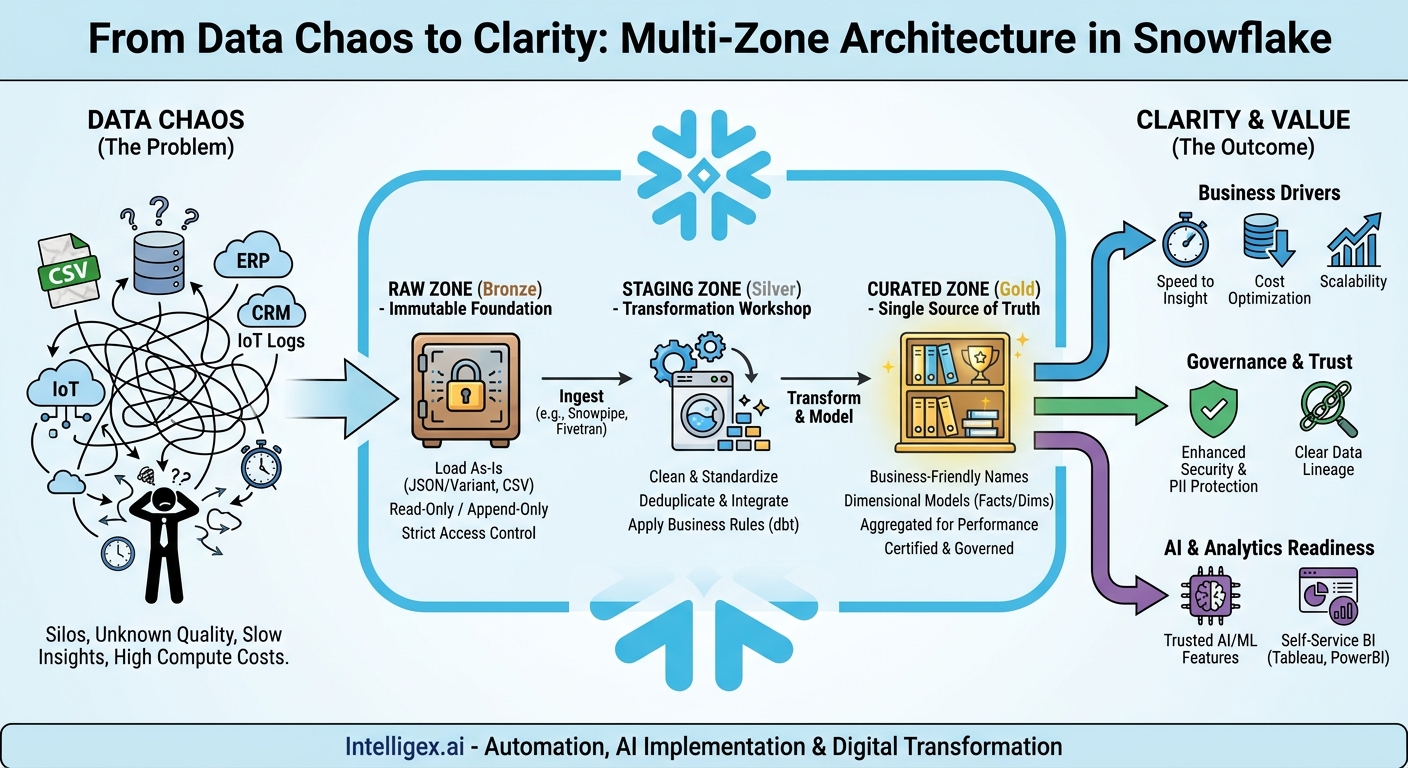
Your data is one of your most valuable assets, but organizing it can feel like an endless battle. Teams pull different numbers for the same metric, reports take days to refresh, and no one is quite sure which data to trust. This chaos doesn’t just slow down decision-making; it actively undermines it. In a modern data platform like Snowflake, simply dumping data into a single location is a recipe for escalating costs and confusion. The solution lies not in more powerful hardware, but in smarter architecture.
A multi-zone data architecture, often called a medallion architecture (bronze, silver, gold), provides a clear, scalable framework for managing data from its rawest form to its most refined state. By establishing distinct zones for Raw, Staging, and Curated data, you create a logical pipeline that enhances data quality, improves security, and accelerates the delivery of insights. This approach transforms your data warehouse from a cluttered storage closet into a well-organized library where every piece of information has a place and a purpose.
The Business Case for a Multi-Zone Data Architecture
Implementing a structured data environment isn’t just an IT exercise; it’s a strategic business decision that delivers tangible value across the organization. When your data is organized, it becomes more accessible, reliable, and cost-effective to use. Let’s break down the core benefits.
Key Business Value Drivers
- Speed to Insight: When analysts and business users know where to find clean, reliable data, they can build reports and dashboards in hours, not weeks. The Curated Zone acts as a self-service layer, empowering teams to answer their own questions without waiting in a long data engineering queue.
- Improved Data Quality and Trust: A multi-zone approach enforces a quality control process. Data is systematically cleaned, validated, and transformed as it moves from Raw to Curated. This traceability means that when the finance team and sales team see different revenue figures, you can quickly trace the lineage of each number back to its source to find the discrepancy. This builds trust in the data and the decisions based upon it.
- Cost Optimization: Snowflake’s architecture separates storage from compute, meaning you pay for what you use. By processing data once and storing the clean, transformed results in the Curated Zone, you avoid running the same complex, expensive queries over and over again on raw data. This “compute once, read many times” pattern significantly reduces credit consumption.
- Scalability and Maintainability: As your company grows, so will your data sources and analytics needs. A zoned architecture is inherently modular. Adding a new data source, like a marketing automation platform, is a straightforward process of establishing a new pipeline into the Raw Zone and building transformation logic, without disrupting existing curated models.
Consider a common scenario for a supply chain team. They need to analyze supplier performance by combining purchase order data from their ERP, shipping manifests from their logistics partner, and quality control reports from a separate system. Without a structured architecture, an analyst would have to manually acquire, clean, and join these disparate files for every new request. With a multi-zone design, this data is automatically ingested, cleaned, and joined into a single, trusted `fact_supplier_performance` table in the Curated Zone, ready for immediate analysis.
The Raw Zone: Your Data’s Immutable Foundation
The Raw Zone (sometimes called the landing zone or bronze layer) is the first stop for all data entering your Snowflake environment. Its primary purpose is to serve as an exact, untransformed, and permanent copy of the source data. Think of it as a digital archive of original documents. You never modify the originals; you only work with copies.
Core Principles and Practices
- Load As-Is: Data should be loaded into the Raw Zone with zero transformations. If a source system sends you a messy CSV file or a nested JSON object, you load it exactly as it is. Snowflake’s `VARIANT` data type is incredibly powerful for handling semi-structured data like JSON without needing to define a schema upfront.
- Structure for Clarity: Organize your Raw Zone logically to mirror the source systems. A common and effective naming convention is `DATABASE.SCHEMA.TABLE`, where the schema represents the source. For example, data from your Salesforce account object would land in `RAW_DB.SALESFORCE.ACCOUNT`.
- Prioritize Immutability: Data in the Raw Zone should be treated as append-only. Once written, it should never be updated or deleted. This ensures you always have the original source record to refer back to, which is critical for debugging, auditing, or reprocessing data if a mistake is found in downstream logic.
- Strict Access Control: Access to the Raw Zone should be highly restricted. Only data ingestion service accounts and the data engineering team should have write permissions. Most other users, including analysts, should have no access at all to prevent accidental modification or reliance on unprocessed data.
Common Pitfalls to Avoid
The biggest mistake teams make is performing “just a little” cleaning in the Raw Zone. Resist the temptation. Applying transformations here, even simple ones like renaming a column or changing a date format, breaks the principle of immutability. If that transformation logic later turns out to be flawed, you have no way to fix it without completely reloading the data from the source, which can be expensive and time-consuming.
The Staging Zone: The Workshop for Transformation
If the Raw Zone is the archive, the Staging Zone (or silver layer) is the workshop. This is where the raw materials are cleaned, shaped, conformed, and assembled. It is an intermediate layer where data is prepared for its final presentation in the Curated Zone. Data in this zone is typically not meant for direct consumption by business users.
Key Activities in the Staging Zone
The Staging Zone is where your data engineering and analytics engineering teams apply business logic and data quality rules. This is the heart of your transformation pipeline.
- Cleansing and Standardization: This includes tasks like casting data to the correct types (e.g., converting a text string ‘2024-05-21’ to a proper `DATE`), standardizing categorical values (e.g., mapping ‘USA’, ‘U.S.A.’, and ‘United States’ to a single ‘US’ value), and handling nulls appropriately.
- Deduplication: Source systems can sometimes send duplicate records. The Staging Zone is where you implement logic to identify and remove these duplicates, ensuring each event or entity is represented only once.
- Enrichment and Integration: This is where you combine data from different sources to create a more complete picture. For example, you might join customer data from your CRM with support ticket data from your helpdesk system to create a single, unified view of a customer’s interactions.
- Applying Business Rules: You can start to apply simple business logic here, such as flagging invoices that are past their due date or calculating the duration of a user session from start and end timestamps.
For an HR team, the Staging Zone is where they might join employee data from their HRIS with payroll data from a separate system, ensuring employee IDs are conformed and matched correctly before creating a unified employee model.
Staging Zone Health Checklist
Use this checklist to guide your work in the Staging Zone:
- [ ] Are all data types cast correctly and consistently?
- [ ] Is there a single, standardized timezone for all timestamp data (e.g., UTC)?
- [ ] Have known duplicates been removed?
- [ ] Are keys used for joining tables (e.g., `customer_id`, `email`) clean and reliable?
- [ ] Have you handled or filtered out records that fail basic quality checks?
The Curated Zone: The Polished Product for Business Users
The Curated Zone (or gold layer) is the final destination. It contains data that is clean, validated, business-friendly, and optimized for analytics. This is the “single source of truth” your organization will use for reporting, dashboards, and analysis. Data in this zone is designed for consumption, not transformation.
Characteristics of Curated Data
- Business-Friendly Naming: Column names are intuitive and descriptive (e.g., `acct_id` becomes `AccountID`, `trans_ts` becomes `TransactionTimestamp`).
- Organized for Analytics: Data is often modeled into facts and dimensions (a Kimball-style dimensional model). For example, you would have a `fact_sales` table containing metrics like `OrderQuantity` and `TotalRevenue`, which connects to dimension tables like `dim_customer`, `dim_product`, and `dim_date`.
- Aggregated and Performant: While you can build models at the most granular level, the Curated Zone is also where you create useful aggregations (e.g., daily sales summaries, monthly active users) to speed up common queries from BI tools like Tableau or Power BI.
- Certified and Governed: Data in this zone should be considered “certified.” This means it has passed data quality tests, has a clear owner, and is documented in a data dictionary or catalog.
An operations team would use the Curated Zone to access a `fact_production_output` table. This table would contain clean, aggregated data on units produced per hour, defect rates, and machine uptime, allowing them to monitor plant efficiency in near-real time without ever having to touch raw sensor data.
A Practical Step-by-Step Implementation Guide
Moving from theory to a functioning multi-zone architecture in Snowflake involves a series of deliberate steps. Following a structured process ensures your foundation is solid and scalable.
- Establish Naming Conventions and Standards: Before writing a single line of code, agree on a consistent naming convention for everything: databases, schemas, tables, and columns. A common pattern is prefixing databases or schemas by zone (e.g., `RAW_DB`, `STG_DB`, `CUR_DB`). Document these standards and enforce them through code reviews.
- Configure Role-Based Access Control (RBAC): Security is paramount. Create specific roles in Snowflake for each function and zone. For example, create a `RAW_LOADER` role for ingestion services, a `DATA_ENGINEER` role with read access to Raw and write access to Staging/Curated, and an `ANALYST` role with read-only access to the Curated Zone. Grant permissions to roles, not to individual users.
- Automate Raw Data Ingestion: Use modern data integration tools like Fivetran, Airbyte, or Snowflake’s own Snowpipe to automate the process of loading data into the Raw Zone. Configure these tools to land data in its native format and structure, triggering loads as new data becomes available.
- Build Transformations with a Modern Framework: Use a tool like dbt (data build tool) to manage your SQL-based transformations from Raw to Staging and from Staging to Curated. Tools like dbt allow you to version control your logic, test your data, and automatically document dependencies, bringing software engineering best practices to your analytics code.
- Create Curated Data Marts for Business Needs: Work with business stakeholders to identify their key reporting and analytics requirements. Use these requirements to design your first set of curated data marts. Start with a high-value area, like sales or marketing, to demonstrate value quickly.
- Implement Data Quality Tests: At each stage of the pipeline, implement automated tests. In Staging, test that primary keys are unique and not null. In Curated, test that revenue figures are always positive. These tests catch issues early, before they impact business reports.
Data Governance and AI Readiness in a Zoned Architecture
A well-designed data architecture is the foundation of strong data governance and a prerequisite for developing trustworthy AI and machine learning models. The separation of zones creates natural control points for security, privacy, and quality.
Enhancing Data Governance
The multi-zone structure simplifies governance in several ways. The clear data lineage, from a curated report all the way back to the raw source file, makes auditing and root cause analysis straightforward. The RBAC model ensures that sensitive data in the Raw Zone, such as Personally Identifiable Information (PII), is only accessible by a small, authorized group. PII can be identified and then masked, hashed, or anonymized during the transformation into the Staging Zone, ensuring that analysts and data scientists working in the Curated Zone only see data that complies with privacy regulations like GDPR and CCPA.
Preparing for AI and Machine Learning
AI models are only as good as the data they are trained on. The Curated Zone provides the perfect source for AI development.
- High-Quality Features: The clean, structured, and validated data in curated models serves as a reliable source of features for training machine learning models. This eliminates the need for data scientists to perform their own ad-hoc cleaning, a process that often consumes the majority of their time.
- Safe Implementation: When deploying an AI model that makes automated decisions, safety is critical. A best practice is to have the model write its predictions to a separate schema in your Staging or Curated Zone. This allows for a “human-in-the-loop” review process where an expert can validate the model’s output before it’s used to take action or integrated into core business reports. This creates a safe, auditable feedback loop.
Ultimately, this structured approach ensures that when you build an AI-powered demand forecasting model, you are building it on a foundation of trusted, governed, and well-understood data, dramatically increasing its chances of accuracy and adoption.
Your Next Steps: From Theory to Action
Adopting a multi-zone architecture is a journey, not an overnight switch. The key is to start small, demonstrate value, and build momentum. You don’t need to rebuild your entire data warehouse at once. Instead, focus on a methodical, value-driven approach.
First, identify a single, high-impact business process that is currently hampered by poor data. This could be the monthly financial close, marketing campaign attribution, or inventory management. Map the data sources involved and design a Raw, Staging, and Curated pipeline just for that process. This focused effort will serve as a pilot project to prove the value of the architecture.
As you build, document everything. Create a simple data dictionary that explains what each table and column represents, its source, and who the business owner is. This documentation is invaluable for encouraging self-service analytics and ensuring the new system is maintainable.
Finally, always connect your technical work to a business outcome. Frame the project not as “we are building a three-zone data architecture,” but as “we are providing the sales team with a trusted, daily-refreshed view of their pipeline so they can focus on closing deals instead of wrestling with spreadsheets.” By tying your data strategy directly to business value, you build the support needed to transform how your entire organization uses data.
Your Next Read:
Category:
Get a FREE
Proof of Concept
& Consultation
No Cost, No Commitment!