

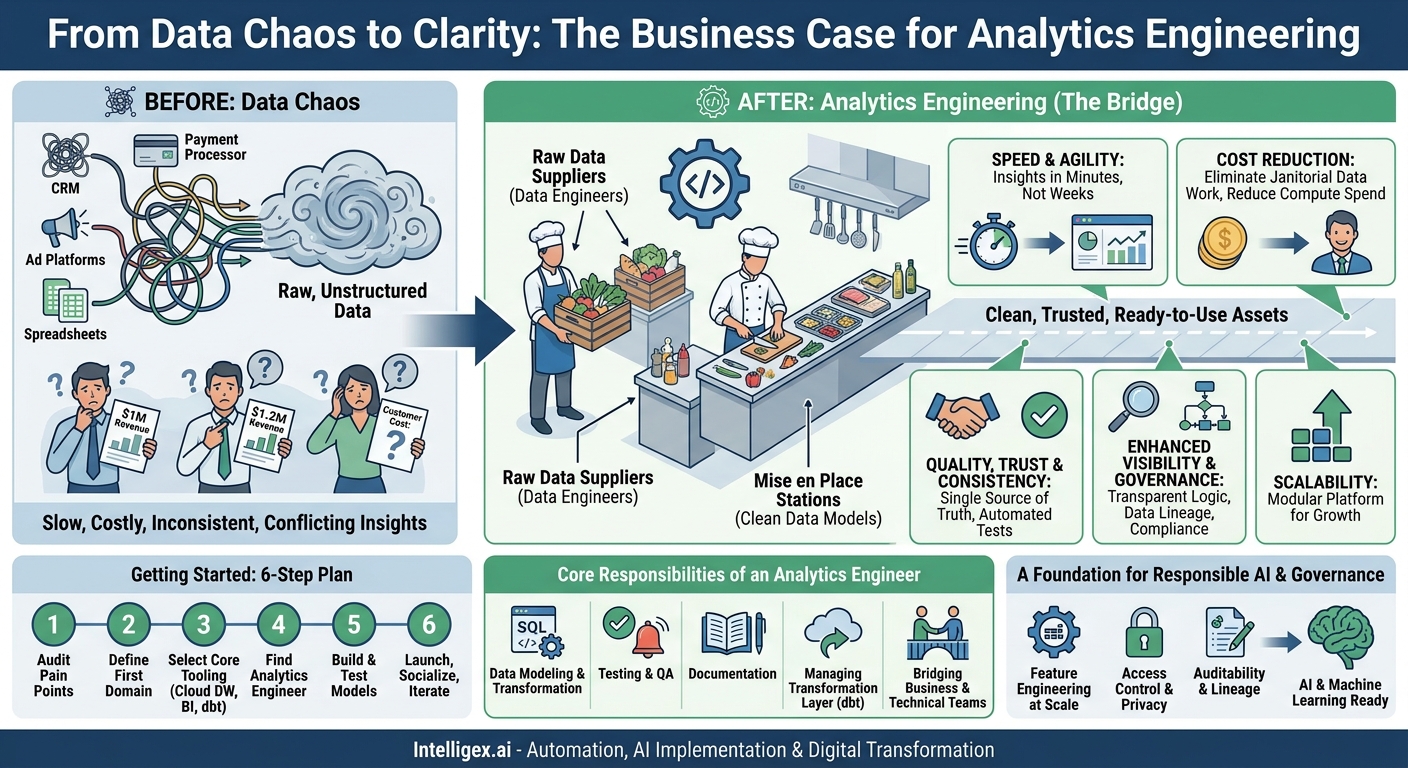
Your business runs on data, but are you running in circles? Teams spend countless hours pulling reports from different systems, only to arrive at meetings with conflicting numbers. Finance has one version of monthly revenue, while Sales has another. Marketing can’t agree on customer acquisition cost. This isn’t a people problem; it’s a data structure problem. You’re drowning in raw data but starving for reliable insights.
This is where analytics engineering comes in. It’s not another buzzword. It’s a critical discipline that transforms chaotic, raw data into clean, trustworthy, and ready-to-use assets for your entire organization. Think of it as the crucial bridge between collecting raw data (data engineering) and using it to make decisions (data analysis and business intelligence). By focusing on this middle layer, analytics engineering directly impacts your business’s speed, costs, and the quality of its decisions.
In this post, we’ll break down what analytics engineering is, why it delivers tangible business value, and how you can start implementing its principles to build a truly data-driven culture.
What Does an Analytics Engineer Actually Do?
The role of an analytics engineer is often misunderstood, sitting uniquely between traditional data engineers and data analysts. A simple analogy can help clarify their function: think of a professional restaurant kitchen.
A data engineer is like the logistics supplier. They ensure the kitchen receives high-quality raw ingredients from various farms and suppliers. They build the robust pipelines that deliver raw data from sources like your CRM, payment processor, and advertising platforms into a central storage area, like a data warehouse.
A data analyst or data scientist is like the head chef. They take prepared ingredients and create the final dishes for the customer. They understand the business context, explore the data, and build the dashboards, reports, and models that answer specific questions and guide strategy.
The analytics engineer is the sous-chef or station chef. They take the raw ingredients delivered by the supplier and perform all the critical prep work. They wash, chop, and organize the ingredients into perfectly prepared, easy-to-use mise en place stations. They transform raw, messy data into clean, well-structured, and logical data models. When the head chef needs to make a dish, they don’t have to start from scratch; they can just grab the prepared components and start cooking. This makes the entire kitchen faster, more consistent, and less prone to error.
In practice, this “prep work” involves a specific set of responsibilities that create a reliable foundation for all analytics.
Core Responsibilities of an Analytics Engineer:
- Data Modeling and Transformation: This is their primary job. They write SQL-based code to clean, join, and reshape raw source data into logical, business-friendly tables. For example, they might create a single table called `fct_orders` that joins data from your e-commerce platform, payment gateway, and shipping provider.
- Testing and Data Quality Assurance: They write automated tests to ensure the data is accurate, fresh, and complete. These tests check for things like duplicates, null values, or if revenue numbers suddenly drop to zero, alerting the team before a CEO sees a broken dashboard.
- Documentation: They create and maintain a “data dictionary” or catalog that explains what each table and column means, where the data comes from, and how it’s calculated. This builds trust and enables self-service analytics.
- Managing the “Transformation” Layer: They own the tools and processes that sit between the raw data warehouse and the end-user’s BI tool. The most common tool for this is dbt (data build tool), which brings software engineering best practices like version control, testing, and modularity to the analytics workflow.
- Bridging Business and Technical Teams: They work closely with business stakeholders to understand their needs and translate them into technical requirements. They also collaborate with data engineers to ensure the raw data pipelines are reliable.
The Business Impact: From Data Chaos to Data Clarity
Implementing analytics engineering isn’t just a technical upgrade; it’s a strategic investment that delivers compounding returns across the organization. It systematically addresses the root causes of data friction, leading to significant improvements in five key areas.
1. Speed and Agility
Before: When a new business question arises, an analyst’s workflow is slow and repetitive. They must find the right raw tables, perform the same cleaning and joining logic as their colleagues (often with slight variations), and then finally begin their analysis. A request like “What’s the lifetime value of customers acquired through our Q2 campaign?” could take weeks.
After: The analyst starts with a pre-built, trusted data model like `dim_customers`. This table already contains all the necessary information, cleaned and documented. The analyst can query it directly, delivering insights in hours or even minutes. This speed allows the business to react faster to market changes, optimize campaigns in-flight, and make timely strategic decisions.
2. Cost Reduction
The costs of poor data practices are often hidden. They include the wasted salary-hours of highly paid analysts doing janitorial data work, the cost of redundant computing power from every analyst running similar, heavy queries on raw data, and the massive opportunity cost of bad decisions made from flawed information. Analytics engineering centralizes the data transformation process, meaning the complex, resource-intensive work of cleaning and modeling data is done once, correctly, and efficiently. This reduces computational spend and frees up your analytics team to focus on high-value work that drives revenue and innovation.
3. Quality, Trust, and Consistency
Before: Two teams present reports with different numbers for the same metric. Why? Because one analyst filtered out test accounts, and the other didn’t. One included refunds, and the other didn’t. This erodes trust in data and leads to meetings where people argue about the numbers instead of the strategy.
After: An analytics engineer codifies the business logic for key metrics like “Active User” or “Net Revenue” into a central data model. This model is automatically tested and documented. Now, everyone in the company, from the intern to the CFO, is using the exact same definition. This creates a single source of truth, eliminating ambiguity and building the foundational trust required for a data-driven culture. A key metric to track here is the reduction in “data-related support tickets” or “time to resolve data quality issues.”
4. Enhanced Visibility and Governance
When business logic is hidden inside a complex dashboard file on an analyst’s laptop, nobody knows how a number is truly calculated. This is a huge risk for compliance and governance. Analytics engineering makes all transformation logic transparent. The code is version-controlled in a repository like Git, so you have a full history of every change made to a metric’s definition. This data lineage is crucial for audits and for debugging issues. You can trace any number in a final report all the way back to its raw source, providing complete visibility into your data’s journey.
5. Scalability
As your company grows, so does your data volume and complexity. The “everyone for themselves” approach to analytics breaks down quickly. Every new analyst you hire has to re-learn the tribal knowledge of navigating the data warehouse, and every new data source adds another layer of chaos. A well-designed data foundation built by analytics engineers is scalable. It provides a stable, modular platform where new data sources can be integrated cleanly and new analysts can become productive on day one by building on top of existing, trusted models.
Getting Started: A 6-Step Plan to Launch Your Analytics Engineering Function
Adopting analytics engineering doesn’t require a massive, multi-year overhaul. You can start small, prove the value, and build momentum. Here is a practical, phased approach to get you started.
- Conduct a Pain Point Audit: Before you build anything, understand the problem. Interview stakeholders in Finance, Marketing, Sales, and Operations. Ask them: “Which reports take the longest to build?”, “Which numbers do you trust the least?”, and “How much of your team’s time is spent arguing about data validity?” Their answers will point you to the highest-impact area to start with.
- Define Your First “Source of Truth” Domain: Don’t try to boil the ocean. Pick one critical business area to focus on first. For many companies, this is either revenue or customer activity. Get key stakeholders from different departments to agree on the exact definitions for 3-5 core metrics (e.g., Monthly Recurring Revenue, Churn Rate, Daily Active Users). Document these definitions.
- Select Your Core Tooling: The foundation of modern analytics engineering is a modular toolkit. You’ll need three main components: a cloud data warehouse (like Snowflake, Google BigQuery, or Amazon Redshift) to store your data, a BI tool (like Tableau, Power BI, or Looker) for visualization, and a transformation tool to connect them. For the transformation layer, the industry standard is dbt (data build tool). It allows you to build data models with simple SQL and brings the discipline of software engineering to the process.
- Find Your First Analytics Engineer: This might be a new hire or, more often, an existing data analyst who shows a knack for structured thinking and technical details. Look for someone with strong SQL skills, a desire to build reusable systems, and an understanding of business logic. Invest in their training on tools like dbt and Git.
- Build and Test Your First Data Models: With your pilot domain and engineer in place, build your first set of core data models. For a revenue project, this might be a `stg_payments` table that cleans your Stripe data and a `fct_revenue` table that aggregates it monthly. Write data tests to check for things like `revenue_amount` never being negative. Make the code and documentation available for review.
- Launch, Socialize, and Iterate: Work with a small group of friendly data analysts to use your new models to rebuild a key dashboard. When they see how much faster and more reliable it is, they will become your biggest advocates. Publicize this success, and then use the momentum to identify the next business domain to tackle.
Common Pitfalls and How to Avoid Them
As with any new function, there are common traps that can derail your progress. Being aware of them from the start can help you navigate the journey successfully.
Pitfall 1: Treating It as a Pure IT Project
The Trap: The data team goes into a back room for six months to build the “perfect” data model without consulting the business users. When they finally unveil it, it doesn’t meet the business’s actual needs, and nobody uses it.
How to Avoid It: Analytics engineering must be a deeply collaborative function. The analytics engineer should be embedded with business teams, participating in their meetings and understanding their challenges firsthand. The development process should be agile, with frequent check-ins and feedback loops to ensure what’s being built is what’s truly needed.
Pitfall 2: Neglecting Documentation and Testing
The Trap: Under pressure to deliver dashboards quickly, the team skips writing tests and documenting their models. They build something that works today, but a month later, when a source system changes, the data breaks silently. Nobody knows why the numbers are wrong or how to fix it. You’ve just created a faster, more sophisticated version of the old chaos.
How to Avoid It: Instill discipline from day one. Make documentation and testing a non-negotiable part of the definition of “done.” Every new column added to a data model should have a plain-English description. Every model should have, at a minimum, tests for uniqueness and non-null values on its primary keys. This upfront investment pays for itself tenfold in saved debugging time and increased user trust.
Pitfall 3: Aiming for Perfection on Day One
The Trap: The team tries to model every single data source and business process across the entire company in one massive project. The scope becomes unmanageable, the project drags on for over a year with no tangible results, and it eventually loses funding and momentum.
How to Avoid It: Think incrementally. Your goal is not to build a flawless, all-encompassing data cathedral overnight. Your goal is to solve a real, painful business problem in the next 90 days. Pick a narrow scope, deliver clear value, and earn the right to tackle the next problem. Momentum is your most valuable asset.
A Foundation for Responsible AI and Governance
Beyond immediate business intelligence needs, analytics engineering provides the essential groundwork for more advanced applications like machine learning and AI. You cannot build reliable AI models on a foundation of chaotic, untrustworthy data. AI systems are incredibly sensitive to the quality of their training data; the “garbage in, garbage out” principle applies with extreme prejudice.
A mature analytics engineering practice directly supports a robust governance and AI readiness strategy:
- Feature Engineering at Scale: AI models need well-defined “features” for training. An analytics engineer creates these features as clean, stable columns in data models (e.g., `customer_lifetime_value`, `days_since_last_purchase`). This ensures that model training and live prediction scoring are done using the exact same logic, preventing errors.
- Access Control and Privacy: It’s easier to manage data privacy and access when logic is centralized. You can create specific data models or views that expose only non-sensitive information for general use, while restricting access to tables containing Personally Identifiable Information (PII) to only authorized personnel or systems.
- Auditability and Lineage: When an AI model produces an unexpected prediction, you need to be able to explain why. Because analytics engineering provides clear data lineage, you can trace the data that fed the model all the way back to its source, which is critical for debugging, auditing, and building trust in your AI systems.
Investing in analytics engineering is a direct investment in your company’s future AI capabilities. It ensures that when you’re ready to deploy predictive models, you’re building them on a foundation of rock, not sand.
Your Next Steps: Building a Data-Driven Culture
Analytics engineering is more than a technical role; it’s a strategic capability that transforms data from a confusing liability into a reliable, enterprise-wide asset. It’s the engine of a truly data-driven culture, where decisions are made with speed and confidence because everyone trusts the numbers.
Getting started is about taking focused, incremental steps. Use this checklist to plan your next move:
- Identify your single biggest data bottleneck. Is it the slow pace of financial closing, the inability to measure marketing ROI, or inaccurate inventory forecasting? Pinpoint the most acute pain and make that your starting point.
- Quantify the hidden costs. Talk to your data analysts and business users. Ask them to estimate how many hours per week they spend finding, cleaning, and validating data. The answer will likely be a shocking number that builds a powerful business case for change.
- Explore the modern data stack. If you’re not already on a cloud-native platform, begin researching the tools that enable this workflow. A cloud data warehouse and a transformation tool like dbt are the key pillars.
- Define the role. Start drafting an internal job description for an analytics engineer. Even if you don’t hire immediately, the exercise will clarify the skills and responsibilities you need. You may find you have a data analyst on your team who is a perfect fit for an upskilling opportunity.
By shifting focus from just creating reports to building a reusable, reliable data foundation, you empower your entire organization to move faster, make smarter decisions, and unlock the true potential of your data.
Your Next Read:
Category:
Get a FREE
Proof of Concept
& Consultation
No Cost, No Commitment!
