

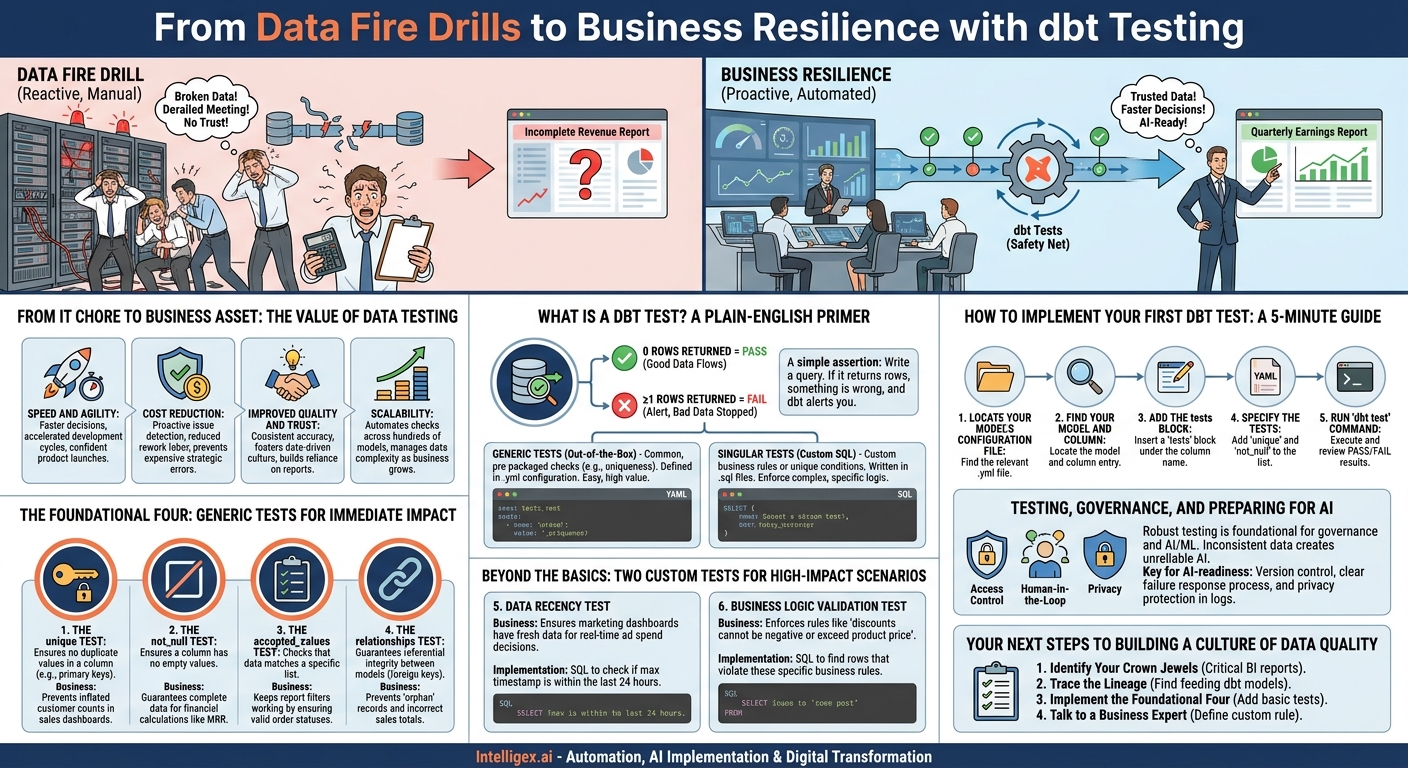
Imagine your Head of Finance is presenting quarterly earnings to the board. The numbers on the slide look wrong. A frantic, behind-the-scenes check reveals the source: a data pipeline failed silently overnight, leading to incomplete revenue calculations. The meeting is derailed, trust in the data evaporates, and your data team spends the next week manually auditing records instead of driving new insights. This scenario is not a technical problem. It is a business catastrophe, and it happens more often than anyone likes to admit.
The root cause is almost always a lack of automated data quality checks. When data flows from sources like Salesforce and your ERP into a data warehouse, and is then transformed for reporting, small errors can cascade into massive reporting failures. This is where dbt (Data Build Tool) testing becomes a non-negotiable part of a modern data strategy. It shifts data quality assurance from a reactive, manual fire drill to a proactive, automated process that runs alongside your data transformations.
By embedding simple tests directly into your data development workflow, you build a safety net that catches issues before they ever reach a C-suite dashboard. This isn’t about technical perfection. It’s about business resilience, speed, and trust. It’s about ensuring that when a decision-maker looks at a report, they are looking at reality.
From IT Chore to Business Asset: The Value of Data Testing
Historically, data quality was seen as a janitorial task for the IT department. Business teams would file a ticket when a report looked “weird,” and a data engineer would begrudgingly investigate. This approach is slow, expensive, and fails to address the core problem. Automated testing with a tool like dbt fundamentally changes this dynamic, delivering clear business value across several key areas.
- Speed and Agility: When you can trust your data, you can make decisions faster. Automated tests give your teams confidence that the underlying numbers are sound, eliminating the need for days of manual validation before a major product launch or marketing campaign analysis. Development cycles also accelerate because analysts and engineers can build new models without fear of breaking downstream dependencies.
- Cost Reduction: The cost of bad data is immense. It includes the labor hours spent identifying, correcting, and reprocessing flawed data. More importantly, it includes the cost of poor decisions made based on that data. Proactive testing drastically reduces expensive rework and prevents costly strategic errors.
- Improved Quality and Trust: Consistency is the foundation of trust. When your reports are consistently accurate, business leaders begin to rely on them. This trust is a critical asset. It fosters a data-driven culture where decisions are based on evidence, not intuition. Automated tests are the engine of that consistency.
- Scalability: As your business grows, so does your data complexity. Manual checking simply cannot scale. A dbt testing framework allows you to manage data quality across hundreds or even thousands of data models, ensuring that as you add new products, regions, or business units, your data integrity holds strong.
Think of it like manufacturing. No company would ship a car without first running it through a rigorous quality assurance line to check the engine, brakes, and electronics. Your data is a product that your entire company consumes. It requires the same level of automated quality control.
What is a dbt Test? A Plain-English Primer
At its core, a dbt test is a simple assertion you make about your data. You write a query, and if that query returns zero rows, the test passes. If it returns one or more rows, the test fails, and dbt alerts you immediately. This simple “pass/fail” mechanism is incredibly powerful because it stops bad data from moving further down the pipeline.
For example, a test could assert: “Find me any orders in my final `orders` table that do not have a customer ID.” If an error in an upstream model causes customer IDs to be dropped, this query will return rows (the orders with missing IDs), the test will fail, and the data pipeline will be halted. The flawed report is never built, and the finance team is never misled.
dbt offers two main categories of tests, which provide a flexible toolkit for data quality.
Generic Tests (Out-of-the-Box)
These are common, pre-packaged tests that cover the most frequent data quality issues. You don’t need to write any SQL to use them. You simply declare them in a configuration file (a `.yml` file), and dbt handles the rest. They are easy to implement and provide a massive amount of value for very little effort.
Singular Tests (Custom SQL)
These are tests you write yourself to validate a specific business rule or a unique condition in your data. They are just `.sql` files that you save in your `tests` directory. While they require writing SQL, they give you the power to enforce complex, company-specific logic that generic tests can’t cover. For instance, you could write a singular test to ensure that a customer’s first order date is never later than their second order date.
The Foundational Four: Generic Tests for Immediate Impact
Starting with dbt testing can feel overwhelming. The best approach is to begin with the four most essential generic tests. Implementing just these four on your most critical data models can prevent a huge percentage of common data quality errors. You configure these tests in the `.yml` file that corresponds to your dbt model.
1. The unique Test
- What it does: Ensures that every value in a specific column is unique. It’s the check for primary keys.
- Why it matters for business: Imagine a sales dashboard that calculates “Total Customers.” If your `customer_id` column has duplicates, your report will show an inflated customer count, potentially misleading your sales strategy. A `unique` test on `customer_id` in your `dim_customers` model prevents this entirely.
2. The not_null Test
- What it does: Ensures that a column contains no null (empty) values.
- Why it matters for business: A finance model calculating monthly recurring revenue (MRR) relies on every subscription having a `start_date`. If some rows have a null `start_date` due to an import error, they get excluded from the calculation. This under-reports revenue. A `not_null` test on `start_date` acts as a critical safety check for financial accuracy.
3. The accepted_values Test
- What it does: Checks that a column only contains values from a specific list you provide.
- Why it matters for business: An operations team might have a dashboard that filters orders by status. The expected statuses are ‘shipped’, ‘processing’, and ‘cancelled’. If a typo in a source system introduces a new status like ‘shiped’, it can break the dashboard filters or cause those orders to be ignored. An `accepted_values` test ensures data conformity and keeps reports functioning as expected.
4. The relationships Test
- What it does: Guarantees referential integrity. It checks that every value in a column in one model exists in a corresponding column in another model. This is the check for foreign keys.
- Why it matters for business: Your `order_items` table lists every product sold in each order. It has an `order_id` to link back to the main `orders` table. A `relationships` test ensures that every single `order_id` in `order_items` actually corresponds to a real order in the `orders` table. Without this, you could have “orphan” records that lead to incorrect sales totals and make it impossible to trace product sales back to a specific customer or transaction.
Beyond the Basics: Two Custom Tests for High-Impact Scenarios
Once you have the foundational generic tests in place, you can move on to singular tests to enforce your organization’s unique business logic. These tests are SQL queries you write yourself and save as `.sql` files in your `tests` folder. They are your tool for encoding business knowledge directly into your data pipeline.
5. Data Recency Test
Business Scenario: The Marketing Operations team relies on a dashboard showing daily lead acquisition to make real-time adjustments to campaign spending. If the data pipeline is delayed and the dashboard shows data that is 48 hours old, they could be making decisions based on stale information, wasting budget on underperforming campaigns.
What it Measures: This test checks the maximum timestamp in a critical table to ensure it’s within an acceptable threshold of the current time (e.g., within the last 24 hours). It validates data freshness.
How to Implement It: You would create a new file like `tests/assert_orders_is_fresh.sql` containing a query like this:
SELECT *
FROM {{ ref('fct_orders') }}
WHERE order_date < CURRENT_DATE - INTERVAL '1 day'
This query returns rows if the latest `order_date` is older than yesterday. When it returns rows, the test fails, and the team is alerted to the data delay.
6. Business Logic Validation Test
Business Scenario: The Finance team has a strict rule: a product discount can never be negative, nor can it be larger than the product’s total price. An error in the data entry or transformation logic that violates this rule could lead to nonsensical profit margin calculations and completely erode trust in financial reports.
What it Measures: This test scans for rows that violate a fundamental business rule. It codifies the logic that “just makes sense” to business users but is often assumed rather than explicitly checked.
How to Implement It: Create a file like `tests/assert_valid_discounts.sql` with a query to find violations:
SELECT *
FROM {{ ref('fct_order_items') }}
WHERE discount_amount < 0 OR discount_amount > item_price
If any order item has an invalid discount, this query returns those rows, the test fails, and the data team can investigate before the flawed data contaminates financial models.
How to Implement Your First dbt Test: A 5-Minute Guide
Theory is great, but practical application is better. Adding your first tests is surprisingly straightforward. Let’s add `unique` and `not_null` tests to a `user_id` column in a hypothetical `dim_users` model.
- Locate Your Model’s Configuration File: In your dbt project, find the `.yml` file where your models are defined. It might be named `schema.yml` or have a name specific to that group of models, like `models/marts/core.yml`.
- Find Your Model and Column: Inside the `.yml` file, find the entry for the `dim_users` model and then the `user_id` column within it. If it doesn’t exist, you’ll need to add it.
- Add the `tests` Block: Directly under the `name: user_id` line, add a `tests` block. The indentation is important in YAML files.
- Specify the Tests: Add `unique` and `not_null` to the list. The final configuration should look something like this:
version: 2models:
- name: dim_users
columns:
- name: user_id
description: "The unique primary key for each user."
tests:
- unique
- not_null - Run the Test Command: Open your command line, navigate to your dbt project directory, and run the command: `dbt test`.
- Review the Results: dbt will now run the SQL queries for the `unique` and `not_null` tests against your `dim_users` table in the data warehouse. It will report back `PASS` or `FAIL` for each test. If it fails, it will tell you exactly which test failed, allowing you to investigate immediately.
You have just implemented a powerful, automated check on one of your most important data assets. The next step is to repeat this process for the primary keys of all your core data models.
Testing, Governance, and Preparing for AI
A robust testing suite is not just about creating reliable dashboards. It’s a foundational element of data governance and a prerequisite for leveraging your data for more advanced applications like AI and machine learning. An AI model is only as good as the data it’s trained on. Feeding it inconsistent, incomplete, or inaccurate data will produce unreliable and potentially harmful predictions.
Integrating testing into your governance framework involves a few key considerations:
- Access Control: Changes to data models and their tests should go through a version control system (like Git) with a pull request and review process. Not just anyone should be able to alter a test that validates financial data. A senior data team member or a business domain expert should review and approve the logic.
- Human-in-the-Loop for Failures: An automated test failure should trigger a clear process. This doesn’t always mean stopping everything. It means creating a ticket, notifying the right team (e.g., via Slack or email), and having a human investigate the root cause. The goal is visibility and rapid response, not blind automation.
- Privacy and Security: Be mindful when writing tests on models containing personally identifiable information (PII). Ensure that test failure logs do not expose sensitive data. dbt’s logging is generally safe, but when writing custom tests, avoid selecting and outputting sensitive columns in your failure messages.
By building a comprehensive test suite, you are creating a dataset that is “AI-ready.” You have a verifiable, machine-readable record of your data’s quality and the business rules it adheres to. This dramatically de-risks AI projects and accelerates the path from data to valuable predictive insights.
Your Next Steps to Building a Culture of Data Quality
Starting with dbt testing doesn’t require a massive, months-long project. It’s an incremental process that builds value with each new test you add. The key is to be strategic and focus on high-impact areas first.
Here is a simple action plan to get started:
- Identify Your Crown Jewels: Get together with your business intelligence team and identify the 3-5 most critical reports or dashboards in the company. These are the ones used by leadership to make important decisions.
- Trace the Lineage: For each of those reports, trace the data back to the primary dbt models that feed them. These are your most critical models and the best place to start testing. You can often find this information in your BI tool or using dbt’s documentation features.
- Implement the Foundational Four: For each of those critical models, add the `unique` and `not_null` tests to their primary keys. Then, add `relationships` tests to connect them to each other. This is your baseline safety net.
- Talk to a Business Expert: Schedule 30 minutes with a power user of one of those critical reports (e.g., a financial analyst or marketing manager). Ask them this question: “What is one rule about this data that, if it were broken, would make you stop trusting this report completely?” Their answer is the specification for your first custom, singular test. Implement it.
By following these steps, you move from a reactive state of fixing bad reports to a proactive state of building trusted data assets. You begin building a culture where data quality is a shared responsibility, automated and embedded into the very fabric of how you work. The result is less time spent fighting fires and more time spent delivering the insights that move your business forward. For more information on getting started, we recommend visiting the official dbt website at https://www.getdbt.com/.
Your Next Read:
Category:
Get a FREE
Proof of Concept
& Consultation
No Cost, No Commitment!