

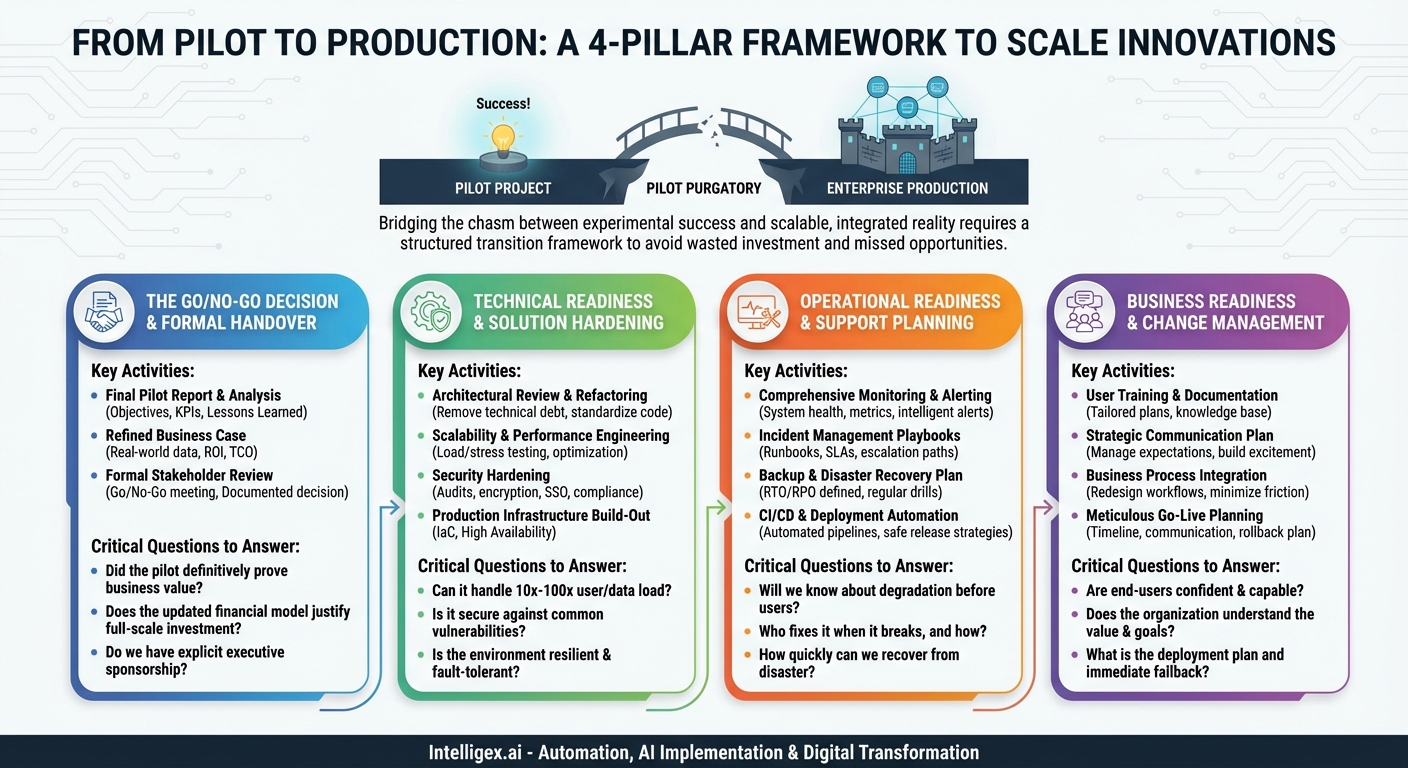
The moment is electric. After weeks or months of dedicated effort, your pilot project is a resounding success. The new AI-powered recommendation engine, the streamlined workflow automation, or the innovative data analytics platform has proven its value in a controlled environment. Stakeholders are impressed, the pilot team is celebrating, and the potential for real business impact feels tantalizingly close. But then, a strange and frustrating silence descends. The project, brimming with promise, stalls. It never makes the leap from the sandbox to the enterprise stage. This all-too-common scenario is known as “pilot purgatory,” a limbo where innovation goes to die. The chasm between a successful pilot and a robust, scalable, and fully integrated production system is vast. Crossing it requires more than just enthusiasm; it demands a structured, deliberate, and comprehensive Pilot-to-Production Transition Framework.
This framework acts as the essential bridge, guiding a promising concept from a limited-scope experiment to an enterprise-grade reality. Without it, organizations risk wasting the investment made in the pilot phase and, more importantly, failing to capitalize on the very innovations that are supposed to drive them forward.
Why a Formal Transition Framework is Non-Negotiable
It’s tempting to think that scaling up is simply a matter of “more”—more servers, more users, more data. This assumption is a primary reason why transitions fail. A framework forces a shift in mindset from “proof of concept” to “product.” It’s the disciplined process that addresses the fundamental differences between a pilot and production.
- Systematic De-risking: Pilots are designed to prove value, often by taking shortcuts. They might use sample data, operate with a small, expert user group, and run on non-production infrastructure. A framework compels teams to systematically identify and mitigate the myriad of risks—technical, operational, security, and financial—that were not present or relevant during the pilot phase.
- Engineering for Scale: A solution that performs flawlessly for 50 pilot users can crumble under the weight of 5,000 concurrent users. The framework mandates rigorous scalability and performance testing, architectural reviews, and code hardening to ensure the system is resilient, efficient, and reliable at production-level loads.
- Cross-Functional Alignment: A pilot is often the passion project of a small, agile team. Production, however, is a team sport involving IT operations, cybersecurity, legal, compliance, customer support, finance, and marketing. A transition framework provides a common language and set of milestones, ensuring all these disparate groups are aligned, informed, and prepared for their respective roles in the launch and ongoing support of the system.
- Justifying and Securing Resources: Moving to production requires a significant increase in investment—for robust infrastructure, software licenses, dedicated support staff, and training. The framework provides the structure for building a refined, data-backed business case based on pilot results, making it far easier to justify the Total Cost of Ownership (TCO) and secure the necessary budget and headcount from leadership.
The Four Pillars of a Successful Transition Framework
A robust Pilot-to-Production framework can be broken down into four critical pillars. Each pillar represents a distinct phase of work with its own set of activities, deliverables, and critical questions that must be answered before moving to the next. Skipping or short-changing any of these pillars dramatically increases the risk of failure.
Pillar 1: The Go/No-Go Decision & Formal Handover
This initial pillar is the formal gate between the experimental world of the pilot and the structured world of production. It’s about making a conscious, data-driven decision to proceed and officially commissioning the transition project.
Key Activities:
- Final Pilot Report & Analysis: The pilot team must produce a comprehensive final report. This document goes beyond a simple summary of results. It must detail the original objectives, the methodology used, quantitative and qualitative outcomes, and a transparent analysis of which Key Performance Indicators (KPIs) were met, exceeded, or missed. Crucially, it must include a “lessons learned” section to inform the production build.
- Refined Business Case: The initial business case that justified the pilot was based on assumptions. Now, armed with real-world data from the pilot, this document must be updated. This refined version should include more accurate projections for Return on Investment (ROI), TCO, and strategic value. It becomes the foundational document for securing production funding.
- Formal Stakeholder Review: This isn’t an informal chat; it’s a formal Go/No-Go meeting. All key sponsors, business owners, and technical leads convene to review the pilot report and the refined business case. The outcome of this meeting is a documented decision: either to approve the transition to production, to send the project back for further piloting with modified goals, or to shelve it.
Critical Questions to Answer:
- Did the pilot definitively prove the business value we hypothesized?
- Does the updated financial model (ROI, TCO) still justify the full-scale investment?
- Do we have explicit, enthusiastic executive sponsorship to carry this project forward?
Pillar 2: Technical Readiness & Solution Hardening
This is where the real engineering work begins. The goal is to transform the pilot’s often-brittle prototype—held together by “duct tape and dreams”—into a robust, secure, and scalable enterprise application.
Key Activities:
- Architectural Review and Refactoring: The architecture that worked for the pilot may not be suitable for production. This phase involves a deep-dive review to identify and address bottlenecks, single points of failure, and scalability issues. It also means paying down technical debt—refactoring poorly written code, improving documentation, and standardizing the codebase for long-term maintainability.
- Scalability and Performance Engineering: The system must be subjected to rigorous load testing, stress testing, and endurance testing. The goal is to simulate and exceed expected production traffic to see where it breaks. This isn’t just about finding the breaking point; it’s about profiling the application to understand its performance characteristics and optimizing code, database queries, and infrastructure accordingly.
- Security Hardening: Production systems are prime targets. This involves a multi-layered security approach: conducting formal security audits and penetration tests, implementing robust authentication and authorization mechanisms (like SSO), ensuring all data is encrypted both in transit and at rest, and implementing proper logging and vulnerability scanning. Compliance with regulations like GDPR or HIPAA must be validated.
- Production Infrastructure Build-Out: Define and build the final production environment. This includes provisioning servers (cloud or on-premise), configuring production-grade databases with high availability, setting up networking and firewalls, and, ideally, codifying it all using Infrastructure as Code (IaC) tools like Terraform or CloudFormation for repeatability and consistency.
Critical Questions to Answer:
- Can the system gracefully handle 10x or 100x the pilot’s user load and data volume?
- Is the application secure against the OWASP Top 10 and other common vulnerabilities?
- Is the production environment resilient, fault-tolerant, and easily reproducible?
Pillar 3: Operational Readiness & Support Planning
A production system is a living entity that must be managed, monitored, and supported 24/7. This pillar is about building the operational muscle to ensure the system runs smoothly and that when problems occur, they are resolved quickly and efficiently.
Key Activities:
- Comprehensive Monitoring and Alerting: You can’t manage what you can’t see. This involves implementing robust monitoring tools to track system health (CPU, memory, disk), application performance (response times, error rates), and key business metrics. Critically, you must define intelligent alert thresholds and notification policies to ensure the right people are notified of issues before they impact customers.
- Incident Management Playbooks: When an alert fires at 3 AM, the on-call engineer shouldn’t be starting from scratch. Develop detailed runbooks (or “playbooks”) for diagnosing and resolving common issues. Define the support structure (e.g., Level 1, Level 2, Level 3 support), establish clear Service Level Agreements (SLAs), and map out escalation paths.
- Backup and Disaster Recovery (DR) Plan: Hope is not a strategy. A comprehensive backup strategy must be established, and more importantly, a full disaster recovery plan must be created and tested. This involves answering questions like “What is our Recovery Time Objective (RTO)?” and “What is our Recovery Point Objective (RPO)?” and then proving you can meet them through regular DR drills.
- CI/CD and Deployment Automation: Manual deployments are slow, risky, and error-prone. A mature CI/CD (Continuous Integration/Continuous Deployment) pipeline should be established to automate the building, testing, and deployment of new code. A safe deployment strategy, such as blue-green or canary releases, should be chosen to minimize downtime and risk during updates.
Critical Questions to Answer:
- How will we know the system is degraded before our users do?
- Who is responsible when something breaks, and do they have the tools and knowledge to fix it?
- If the primary data center goes offline, how quickly can we failover and what is the potential for data loss?
Pillar 4: Business Readiness & Change Management
The most technically perfect system will fail if users don’t adopt it, if it doesn’t fit into existing workflows, or if the organization isn’t prepared for its launch. This pillar is focused on the human side of the transition.
Key Activities:
- User Training and Documentation: Develop a comprehensive training plan tailored to different user groups. This could include instructor-led sessions, video tutorials, and self-service knowledge bases. Clear, concise, and easily accessible user documentation is not an afterthought; it’s a critical component of successful adoption.
- Strategic Communication Plan: Change can be unsettling. A proactive communication plan is essential to manage expectations, build excitement, and ensure everyone understands the “what, why, and when” of the launch. Communications should be targeted to different audiences, from executive updates to all-hands announcements and departmental briefings.
- Business Process Integration: The new system will inevitably change how people work. Map out the existing business processes that will be impacted and redesign them to incorporate the new tool. Failing to do this can lead to friction, workarounds, and user frustration, as employees try to force the new system into their old ways of working.
- Meticulous Go-Live Planning: The launch itself is a project within a project. The Go-Live plan should include a detailed timeline of events, a communication matrix for launch day, criteria for a successful launch, and, most importantly, a well-defined and tested rollback plan in case of catastrophic failure.
Critical Questions to Answer:
- Are our end-users confident and capable of using the new system on day one?
- Does the organization understand how this new tool will improve their work and contribute to business goals?
- What is our step-by-step plan for deployment day, and what is our immediate fallback if things go wrong?
The journey from a promising pilot to a production powerhouse is one of the most critical—and most frequently fumbled—processes in the innovation lifecycle. By abandoning ad-hoc approaches and embracing a structured Pilot-to-Production Transition Framework, organizations can turn “pilot purgatory” into a “production pipeline.” It requires a shift from a short-term, experimental mindset to a long-term, product-oriented one. This discipline is what transforms a bright idea into a tangible asset that delivers sustained, measurable value to the business. Don’t let your best innovations wither; give them the structured path to production they need to thrive.
Your Next Read:
Category:
Get a FREE
Proof of Concept
& Consultation
No Cost, No Commitment!