Procurement is the lifeblood of any growing organization. It’s how you get the tools, services, and talent you need to innovate and compete. Yet for many teams, the process feels less like a strategic enabler and more like a frustrating maze of delays. A simple request for new software or a critical component can get bogged down for weeks, or even months, in a cycle of emails, spreadsheets, and follow-up meetings. This friction isn’t just an inconvenience; it’s a direct drag on your company’s agility, profitability, and competitive edge. When projects stall waiting for a signature, your speed to market suffers. When teams can’t get the resources they need, their productivity and morale drop.
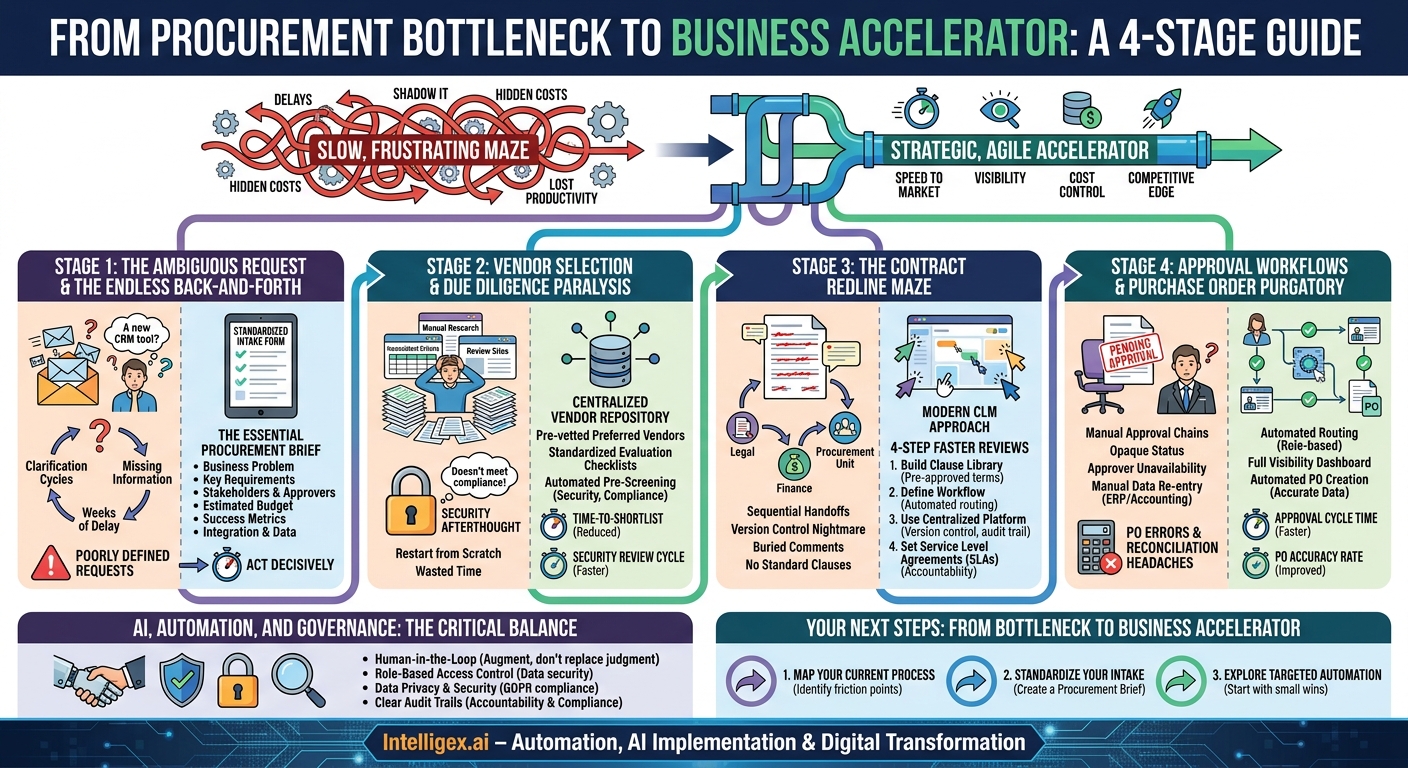
Understanding where these delays happen is the first step toward fixing them. The bottlenecks aren’t random. They occur at predictable stages in the procurement lifecycle, from the initial request to the final purchase order. By dissecting each stage, we can identify the root causes of friction and implement targeted solutions that transform procurement from a bureaucratic hurdle into a powerful business accelerator.
The Hidden Costs of “Hurry Up and Wait” Procurement
The most obvious cost of a slow procurement process is time. A project that could have been completed in one quarter is pushed to the next. But the true business impact runs much deeper and affects everything from your budget to your company culture.
When delays become the norm, teams often resort to workarounds that introduce risk and hidden costs. This is where “shadow IT” thrives, with departments using personal credit cards to buy unvetted software, creating massive security and compliance vulnerabilities. Frustrated engineers might bypass official channels to get the cloud resources they need, leading to uncontrolled spending and a fragmented tech stack. Marketing teams, unable to quickly onboard a new creative agency, might miss a critical campaign window.
The financial costs also accumulate in less obvious ways. A lack of visibility into enterprise-wide spending means you miss opportunities for volume discounts. Rush orders to make up for lost time almost always come with premium pricing. And the sheer amount of manual effort, from chasing approvals to re-entering data between systems, represents thousands of hours of skilled employee time that could be spent on strategic work. The goal isn’t just to make procurement faster; it’s to make it smarter, more visible, and less costly for the entire organization.
Stage 1: The Ambiguous Request and the Endless Back-and-Forth
The first and most common point of failure in procurement happens right at the beginning: the request itself. A poorly defined request is a guarantee for delay. It kicks off a long, frustrating cycle of clarification emails and meetings between the requesting team, procurement, finance, and IT.
Consider this common scenario: the sales team submits a one-line request for “a new CRM tool.” This simple phrase leaves critical questions unanswered. What specific business problem are they trying to solve? How many users will need access? What other systems, like your marketing automation platform or ERP, does it need to integrate with? Are there specific data security and compliance requirements, like GDPR or CCPA? Without this information, the procurement team cannot begin to identify suitable vendors or evaluate solutions. They are forced to become investigators, spending days or weeks just to define the basic scope of the project.
To break this cycle, you must standardize and structure the intake process. The solution is to move away from email and spreadsheet-based requests to a guided, centralized system. This ensures that all the necessary information is collected upfront, giving the procurement and vetting teams everything they need to act decisively.
Checklist: The Essential Procurement Brief
Before any request is submitted, ensure it contains these core elements. Creating a simple template or intake form with these fields can eliminate weeks of back-and-forth communication.
- Business Problem: What specific pain point or opportunity does this purchase address? (e.g., “Our current lead nurturing process is manual and results in a 20% lead drop-off.”)
- Key Requirements: List the 3-5 non-negotiable features or capabilities needed. (e.g., “Must integrate with Salesforce,” “Must be FedRAMP compliant.”)
- Stakeholders & Approvers: Who is the business owner, the budget holder, and the technical lead?
- Estimated Budget: What is the expected cost range for the software or service, including implementation and annual licensing?
- Success Metrics: How will you measure the success of this purchase? (e.g., “Reduce lead drop-off by 15% within six months.”)
- Integration & Data: What other systems will this connect with? What kind of data will it handle?
Stage 2: Vendor Selection and Due Diligence Paralysis
Once a request is clearly defined, the next slowdown often occurs during vendor sourcing, evaluation, and due diligence. This stage is frequently manual, inconsistent, and disconnected from the organization’s strategic goals. Teams spend countless hours on search engines and review sites, creating sprawling spreadsheets to compare vendors. The criteria used for comparison often vary from one purchase to the next, making it impossible to conduct an objective, apples-to-apples analysis.
Worse, the critical security, legal, and financial reviews are often treated as an afterthought. A business team might spend a month falling in love with a vendor’s solution, only to bring it to the security team and discover it doesn’t meet basic compliance standards. The entire process has to start over from scratch, wasting time and causing immense frustration.
The key to accelerating this stage is to centralize vendor information and standardize the evaluation process. By building a pre-vetted repository of preferred vendors and establishing clear, repeatable checklists for different types of purchases (e.g., software, professional services, hardware), you can dramatically reduce the time it takes to create a qualified shortlist. Automation can play a powerful role here by helping to pre-screen vendors against your company’s baseline security and compliance requirements, flagging potential issues before a human reviewer ever gets involved.
What to measure: Track your time-to-shortlist (how long it takes from a defined request to a list of 2-3 qualified vendors) and your average security review cycle time. A reduction in these metrics is a clear indicator of a more efficient process.
Stage 3: The Contract Redline Maze
The contract negotiation and redlining phase is a notorious bottleneck. A draft agreement can bounce between legal, finance, procurement, and the business unit for weeks. The process is often sequential, meaning one person must finish their review before the next can begin. Version control becomes a nightmare, with multiple people editing different copies of the same document, leading to confusion and lost changes.
This slowdown is rarely due to a lack of effort. Legal teams are rightly focused on mitigating risk. The problem is a lack of standardized processes and tools. Without a library of pre-approved legal clauses, lawyers have to draft or review standard terms like indemnification or limitation of liability from scratch for every single contract. Without a centralized platform for negotiation, comments and changes are buried in long email threads.
Implementing a modern contract lifecycle management (CLM) approach, even a simple one, can bring immense value. It transforms the review process from a series of isolated handoffs into a collaborative, parallel workflow where all stakeholders can comment on the same document simultaneously.
A 4-Step Process for Faster Contract Reviews
- Build a Clause Library: Work with your legal team to create a set of pre-approved, standardized clauses for common contract items (e.g., payment terms, data privacy, confidentiality). This allows the procurement team to build draft agreements quickly and confidently, reserving legal’s time for truly unique or high-risk negotiations.
- Define Your Workflow: Establish clear rules for who needs to approve what. A $5,000 software license shouldn’t require the same level of scrutiny as a seven-figure enterprise agreement. Automate the routing based on contract value, risk level, or data type.
- Use a Centralized Platform: Move away from email attachments. A CLM system or even a shared document platform with robust version control and commenting features (like Microsoft 365 or Google Workspace) ensures everyone is working on the latest version and provides a clear audit trail of all changes.
- Set Service Level Agreements (SLAs): Establish expected turnaround times for each stage of the review. For example, Legal has 48 hours for an initial review of a standard contract. This creates accountability and makes it easier to identify and address bottlenecks.
Stage 4: Approval Workflows and Purchase Order Purgatory
Even after a vendor is selected and a contract is signed, the final internal hurdles can bring everything to a halt. This is the world of manual approval chains and purchase order (PO) creation. A request that has already been vetted and approved in principle gets stuck waiting for a final signature from a budget holder who is on vacation, or a senior executive who doesn’t have the context and has to re-ask all the questions that were answered weeks ago.
The process is often opaque. The requesting team has no visibility into where the approval is stuck or who they need to contact. Once approved, the data often needs to be manually re-entered into an ERP or accounting system like SAP or Oracle to generate a PO. This manual data entry is not only slow but also a major source of errors, leading to incorrect payment amounts, mismatched invoices, and future reconciliation headaches for the finance team.
Automating these final steps provides an immediate and significant return on investment. By using a system that integrates your procurement and finance platforms, you can:
- Automate Approval Routing: Automatically send requests to the right people based on department, project code, and spending limits. If an approver is out of office, the system can automatically delegate to a designated backup.
- Provide Full Visibility: A centralized dashboard allows anyone involved in the request to see its current status, who it’s waiting on, and the expected completion date.
- Automate PO Creation: Once the final approval is given, the system can automatically generate a purchase order using the data from the original request and contract, eliminating manual entry and ensuring accuracy.
What to measure: Focus on your average approval cycle time (from final submission to final signature) and your PO accuracy rate. Improving these metrics directly translates to faster execution and a more efficient finance operation.
A Note on AI, Automation, and Governance
As you look to introduce automation and artificial intelligence into your procurement process, it’s critical to do so with a strong governance framework. These technologies offer incredible potential to accelerate reviews and uncover insights, but they also handle sensitive commercial and personal data. A thoughtful approach is essential for safe and effective implementation.
The goal of AI in this context is not to replace human judgment, but to augment it. For instance, AI can review a vendor’s standard contract and flag non-standard clauses or risky language for your legal team to examine more closely. It can analyze your historical spending data to suggest potential cost-saving opportunities. It provides a “first pass” that allows your skilled professionals to focus their expertise where it matters most.
When implementing these tools, prioritize the following principles:
- Human-in-the-Loop: Always ensure that a qualified human makes the final decision. Use automation to suggest, flag, and summarize, but never to auto-approve a complex contract or a high-value purchase without human oversight.
- Role-Based Access Control: Not everyone in the company needs to see the financial details of every contract. Implement strict access controls to ensure employees can only view the information relevant to their role.
- Data Privacy and Security: Any system you use must comply with data privacy regulations like GDPR. Ensure that all vendor and contract data is encrypted, stored securely, and handled according to your company’s data governance policies.
- Clear Audit Trails: Every action taken within the system, from the initial request to the final approval and PO creation, must be logged in an immutable audit trail. This is crucial for compliance, financial audits, and internal accountability.
Your Next Steps: From Bottleneck to Business Accelerator
Fixing procurement isn’t about a single, massive overhaul. It’s about making targeted, incremental improvements at each stage of the process to remove friction and empower your teams. A smooth, predictable procurement process is a strategic asset that allows your entire organization to move faster, control costs, and make better decisions.
Start your journey with a few focused actions:
- Map Your Current Process: Before you can fix the problem, you have to understand it. Gather stakeholders from different departments and visually map your current procurement workflow from request to payment. Identify the one or two stages where delays are most common and painful. Focus your initial efforts there.
- Standardize Your Intake: The single most impactful change you can make is to fix the beginning of the process. Use the checklist above to create a standardized “Procurement Brief” or digital intake form. This alone will eliminate a huge source of confusion and delay.
- Explore Targeted Automation: You don’t need a massive, end-to-end system on day one. Look for opportunities to automate a single, high-friction task. This could be as simple as setting up an automated approval workflow or using a contract management tool to track renewal dates. Small wins build momentum for broader transformation.
By treating procurement as a critical business process worthy of optimization, you can unlock significant value and turn a source of frustration into a true competitive advantage.
Your Next Read:
Category:
Get a FREE
Proof of Concept
& Consultation
No Cost, No Commitment!