

A new sales hire waits a week for CRM access, missing opportunities from day one. A recently promoted manager still has the system permissions of their old role, creating confusion and security gaps. Finance spends the first week of every quarter manually reconciling headcount reports because department names don’t match between the payroll system and the ERP. These aren’t isolated incidents. They are symptoms of a foundational business problem: an inconsistent Employee Master Record.
The Employee Master Record (EMR) should be the single, undisputed source of truth for all data related to your people. When it’s fragmented, outdated, or inconsistent, it creates friction that ripples across every department. This isn’t just an HR or IT administrative task. Building a standardized EMR is a strategic investment in your company’s operational backbone, unlocking speed, reducing costs, and enabling scalable growth.
Why a Messy Employee Record Costs You More Than You Think
The hidden costs of poor employee data management go far beyond administrative headaches. They manifest as tangible drains on productivity, direct financial losses, and significant business risks. By failing to standardize, you are actively choosing inefficiency.
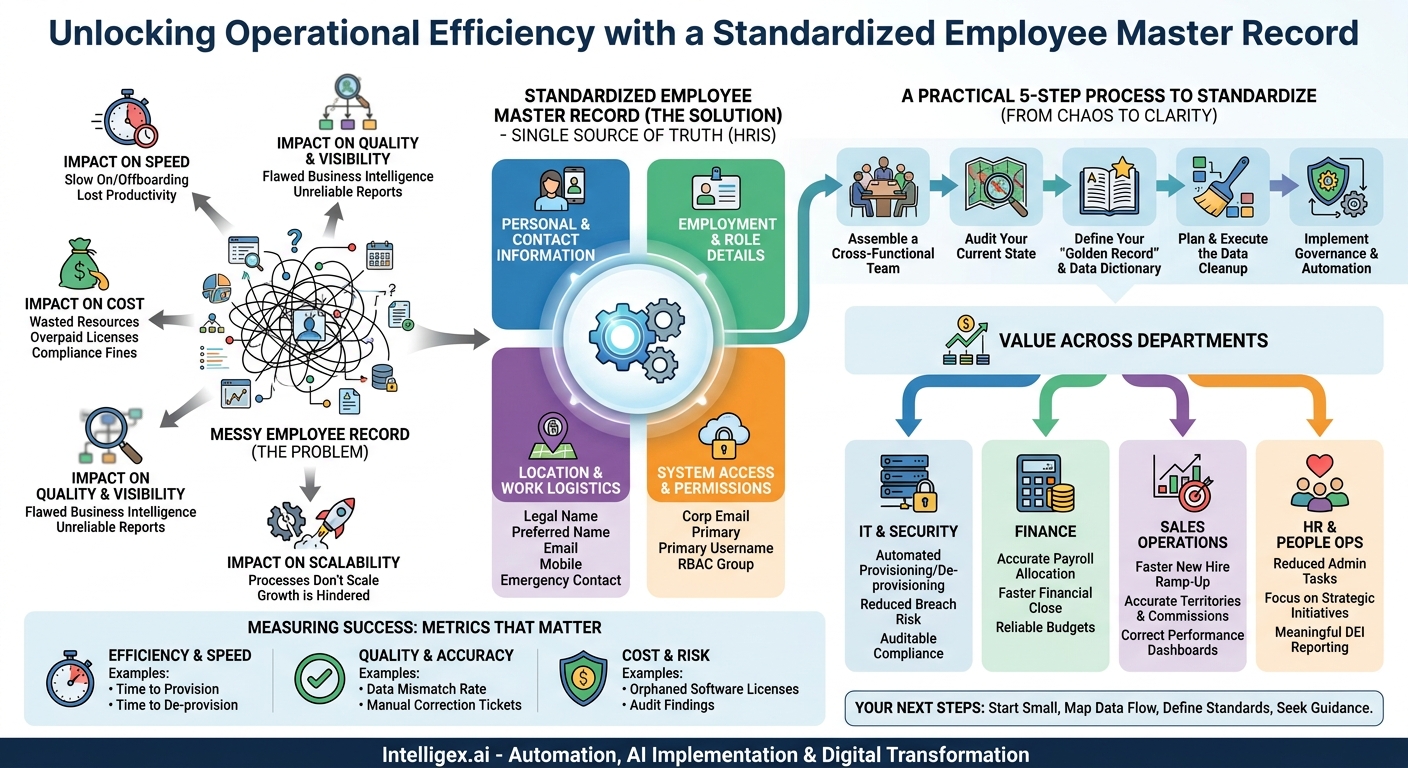
Impact on Speed: The most immediate cost is time. Onboarding and offboarding processes become painfully slow. A new hire’s journey from offer letter to full productivity is delayed by manual requests for system access, equipment, and permissions. Each day of waiting is a day of lost value. Similarly, slow de-provisioning during offboarding leaves a window of unnecessary security risk, where a former employee may retain access to sensitive company data.
Impact on Cost: Wasted resources are a direct financial hit. Your IT, HR, and Finance teams spend countless hours manually cross-referencing spreadsheets, correcting data entry errors, and chasing down approvals. This is low-value work that prevents them from focusing on strategic initiatives. Furthermore, without a clean record of active employees, you are likely overpaying for software licenses, continuing to pay for seats that are no longer in use. In regulated industries, non-compliance due to poor data handling can also lead to significant fines.
Impact on Quality and Visibility: You cannot manage what you cannot measure. Inaccurate employee data leads to flawed business intelligence. Org charts are perpetually out of date. Headcount reports are unreliable. Financial forecasts based on incorrect departmental payroll allocations are misleading. Leaders are forced to make critical decisions based on a distorted view of the organization, undermining strategic planning and operational control.
Impact on Scalability: Manual, inconsistent processes do not scale. What works with 50 employees will break at 500 and become a catastrophic failure at 5,000. As your company grows, acquires other businesses, or expands globally, a non-standardized EMR becomes an anchor, slowing down integration and preventing the very agility you need to succeed.
The Core Components of a Standardized Employee Master Record
Creating a reliable EMR starts with defining what data matters and establishing strict, non-negotiable standards for it. Think of these as the foundational pillars of your employee data architecture. While every business is different, a robust master record generally includes four key domains.
Personal and Contact Information
This is the most basic information identifying the individual. Consistency here is key for communication and legal compliance.
- Fields to Standardize: Legal Name (First, Middle, Last), Preferred Name, Personal Email Address, Mobile Phone Number, Emergency Contact Information.
- Why it Matters: A standard format for names (e.g., rules for suffixes like Jr. or III) and phone numbers (e.g., mandatory country codes) prevents duplicate records and ensures payroll, benefits, and emergency communications reach the right person without errors.
Employment and Role Details
This domain is the operational core of the EMR. It defines an employee’s position, function, and relationship to the rest of the organization. This is where inconsistency causes the most downstream damage.
- Fields to Standardize: Employee ID, Job Title, Department, Cost Center, Manager/Supervisor, Employment Type (Full-Time, Part-Time, Contractor, Intern), Hire Date, Termination Date.
- Why it Matters: The Employee ID must be a unique, permanent, and system-agnostic identifier for each person. Job titles, departments, and cost centers should never be free-text fields. They must be selected from a predefined, governed list managed by HR and Finance. This single step eliminates the chaos of “Sales” vs. “Revenue Team” and ensures financial and operational reports are always accurate.
Location and Work Logistics
This information defines where and how an employee works, which has implications for tax, facilities management, and team collaboration.
- Fields to Standardize: Office Location/Site Code, Remote/Hybrid Status, Work Address (for fully remote staff).
- Why it Matters: Using standardized site codes (e.g., “NYC-01” for the New York office) allows for easy reporting on geographic distribution and resource allocation. It also ensures correct tax withholding and helps IT provision location-specific resources.
System Access and Permissions
This domain connects the employee’s role to the tools they need to perform their job. It is the foundation for secure and efficient automation.
- Fields to Standardize: Corporate Email Address, Primary Usernames, Role-Based Access Control (RBAC) Group.
- Why it Matters: By linking an RBAC group directly to a standardized Job Title (e.g., all “Account Executive” titles are assigned to the “Sales-CRM-Access” group), you can automate the process of granting and revoking permissions. A role change in the HR system can automatically trigger the correct access changes across all integrated applications.
A Practical 5-Step Process to Standardize Your EMR
Transforming your employee data from a liability into an asset requires a structured approach. This isn’t a one-time project but the establishment of a new operational discipline. Follow these steps to build a foundation for clean, reliable data.
- Assemble a Cross-Functional Team: This is not just an HR or IT initiative. Your team must include stakeholders who feel the pain of bad data. Nominate a clear project owner and include representatives from HR (data source), IT (systems and security), Finance (payroll and cost centers), and at least one key business unit like Sales or Operations (data consumer). This collaboration ensures the final standard meets everyone’s needs.
- Audit Your Current State and Data Flow: Before you can fix the problem, you must understand it. Map out where all your employee data currently lives. Is the primary source your HRIS? What data is in Active Directory, your ERP, or your CRM? Identify the conflicts. For instance, list every variation of “Marketing” that exists across your systems (“Mktg,” “Marketing Dept,” “Growth Marketing”). This audit will reveal the scope of the cleanup and the most critical integration points.
- Define Your “Golden Record” and Data Dictionary: Formally designate one system as the ultimate source of truth for employee data. For most organizations, this is the Human Resources Information System (HRIS). Then, create a data dictionary. This is a simple document that lists every field in your EMR, its definition, its required format (e.g., text, date, predefined list), and which department is responsible for its accuracy (the “data owner”). For example: Field: Cost Center. Owner: Finance. Format: 5-digit numeric code from the official Chart of Accounts.
- Plan and Execute the Data Cleanup: This is often the most intensive step. Start by prioritizing the most impactful data points: Employee ID, Manager, Department, and Job Title. Use automated scripts to correct data in bulk where possible, but budget time for manual review of edge cases and exceptions. Communicate the process clearly. Let managers know you are validating their team hierarchies and give them a chance to correct errors.
- Implement Governance and Automation: A cleanup project is useless without guardrails to prevent future messes. Lock down key fields to prevent free-text entry. Implement approval workflows for creating new departments or job titles. Most importantly, use integrations to automate the flow of data from your source of truth (the HRIS) to downstream systems. When a manager is changed in the HRIS, that change should automatically propagate to all other relevant systems without manual intervention.
Connecting the Dots: How a Clean EMR Drives Value Across Departments
The true value of a standardized EMR is realized when clean data flows seamlessly across the organization, enabling efficiency and better decision-making for everyone. This isn’t an abstract technical goal; it has a direct, positive impact on day-to-day operations.
For IT and Security: This is the clearest win. With a trustworthy EMR integrated with your identity management system (like Active Directory or Okta), user provisioning and de-provisioning can be fully automated. A termination event entered in the HRIS can trigger an immediate, automated workflow that revokes all system access within minutes, not days. This drastically reduces the risk of data breaches from orphaned accounts and provides a clear, auditable trail for compliance.
For Finance: The finance team can finally achieve accurate, timely reporting. When every employee record has a standardized and correct cost center, allocating payroll, travel expenses, and software costs becomes an automated process. The painful, multi-day manual reconciliation at the end of each month is eliminated. This leads to faster financial closes, more accurate departmental budgets, and greater trust in the numbers presented to leadership.
For Sales Operations: Speed is critical in sales. A clean EMR ensures that when a new Account Executive is hired, their record correctly specifies their manager, team, and role. This allows for the automatic creation of their CRM account, assignment to the correct sales territory, and inclusion in the right commission plan on their very first day. Accurate manager hierarchies in the EMR also mean that sales performance dashboards and commission reports are always correct, eliminating disputes and building trust with the sales team.
For HR and People Operations: By automating routine data management, the HR team is freed from endless administrative tasks. They can shift their focus from fixing data entry errors to strategic initiatives like improving employee engagement, developing talent pipelines, and analyzing workforce trends. A reliable EMR also provides the clean data needed for meaningful Diversity, Equity, and Inclusion (DEI) reporting, helping the organization track progress against its goals.
Measuring Success: Metrics That Matter
To justify the investment in data standardization, it’s crucial to track metrics that demonstrate tangible business improvement. Focus on outcomes, not just data purity.
Efficiency and Speed Metrics
- Time to Provision: Measure the average time from a new hire’s official start date to when they have access to all essential systems (email, CRM, ERP, etc.). The goal is to move this from days to hours.
- Time to De-provision: Track the average time from a termination event being entered in the HRIS to the revocation of all critical system access. This is a key security metric.
Quality and Accuracy Metrics
- Data Mismatch Rate: Periodically compare critical fields (like Manager or Department) between your HRIS and key downstream systems. Track the percentage of records with conflicts and watch it decline over time.
- Manual Correction Tickets: Monitor the number of IT help desk or HR support tickets created each month to fix employee data errors. A reduction here is a direct measure of improved data quality and saved labor.
Cost and Risk Metrics
- Orphaned Software Licenses: Calculate the monthly cost of active software licenses assigned to employees who have already been terminated. A standardized de-provisioning process should drive this number to zero.
- Audit Findings: For companies subject to regulations like SOX or SOC 2, track the number of access-control-related findings in your audits. A well-governed EMR should lead to a significant reduction in these issues.
A Note on Governance and Safe Implementation
Employee data is sensitive, and any project involving it must prioritize security and privacy. Standardization and automation are powerful tools, but they must be implemented with care and oversight.
Principle of Least Privilege: Not everyone in the organization needs to see all the data in the EMR. Implement strict role-based access controls. A line manager may need to see their direct reports’ job titles and office locations, but they should not have access to sensitive information like personal contact details or compensation history unless there is a clear business need.
Data Privacy and Compliance: Standardizing your employee data makes it much easier to manage and protect in accordance with regulations like GDPR. Knowing exactly where data resides and what it is used for is the first step toward building compliant processes for handling data subject access requests and ensuring you have a legal basis for processing personal information.
Keep a Human in the Loop: Automation should enable your processes, not blindly execute them. For critical workflows with significant consequences, such as a termination or a change in compensation, always build in a human review and approval step. The system can prepare and stage the changes, but a person should provide the final confirmation. This balance prevents errors and ensures that context and judgment are applied where they matter most.
Your Next Steps: From Plan to Action
Starting a data standardization initiative can feel daunting, but progress begins with a few focused, practical steps. Don’t try to boil the ocean. Instead, build momentum by targeting the most painful areas first.
- Identify Your Data Champion: Find one person in a leadership position who understands the business cost of bad data and is willing to sponsor the effort.
- Start Small and Focused: Pick one high-impact, high-visibility process to fix first, such as new hire onboarding. Use it as a pilot to prove the value and learn lessons.
- Map a Single Data Flow: Get the key stakeholders in a room with a whiteboard and visually map how employee data moves between your top 3-5 systems today. Pinpoint the exact points of failure and inconsistency.
- Define Your “Good Enough” Standard: You don’t need to standardize 100 fields on day one. Agree on the 10 most critical fields (e.g., Employee ID, Name, Manager, Department, Employment Status) and get them right first.
- Seek Expert Guidance: This is a well-understood business problem. Engaging with partners who have deep experience in data governance and systems integration can help you avoid common pitfalls and accelerate your progress.
Building a standardized Employee Master Record is more than a cleanup project. It’s a fundamental upgrade to your company’s operating system, creating a more efficient, secure, and scalable organization for the future.
Your Next Read:
Category:
Get a FREE
Proof of Concept
& Consultation
No Cost, No Commitment!
