

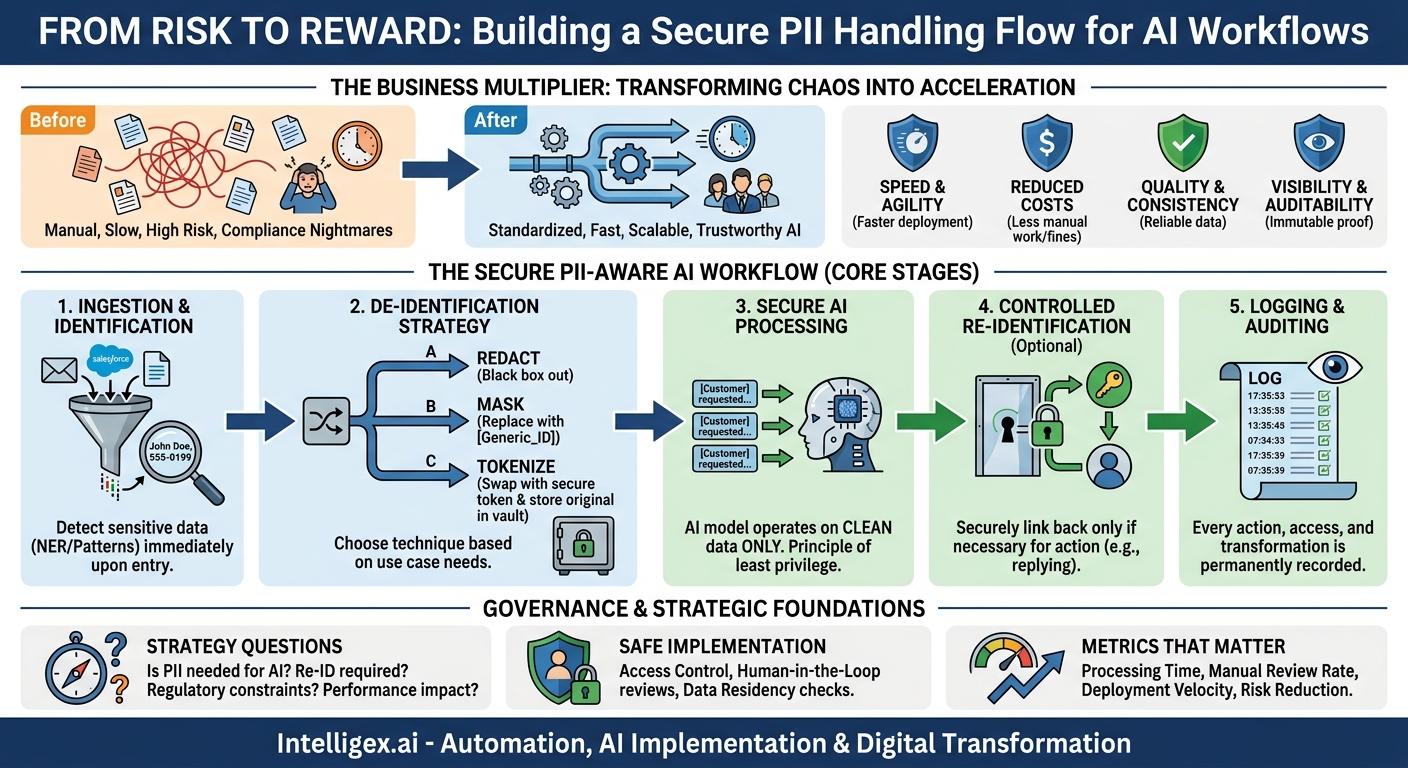
Artificial intelligence offers a powerful way to streamline operations, from automatically categorizing customer support tickets to analyzing financial documents for risk. But these high-value workflows are often fueled by data that contains sensitive, personally identifiable information (PII). Unlocking the value of AI without exposing your business to catastrophic data breaches, regulatory fines, and loss of customer trust requires more than just good intentions. It requires a system.
A structured PII handling flow is not a bureaucratic hurdle; it is a business accelerator. By creating a standardized, repeatable process for identifying and protecting sensitive data, you build a safe foundation for innovation. This allows your teams to deploy new AI-enabled solutions faster, more securely, and with greater confidence. Instead of each new project triggering a lengthy, custom security review, new initiatives can plug into a pre-approved, compliant framework. The result is a direct impact on the bottom line through improved speed, reduced costs, and scalable, trustworthy operations.
Why a Standardized PII Flow is a Business Multiplier
Treating data privacy as an afterthought is a recipe for failure. A proactive, systematic approach to handling PII within your AI workflows provides tangible business advantages that go far beyond simple compliance.
Drive Speed and Agility
When you have a defined process for de-identifying data, the security and legal review for new AI projects becomes dramatically simpler. Your data science and development teams are not starting from zero with every new idea. They can leverage a pre-built, vetted pipeline to safely access the data they need. This shortens development cycles, allowing you to move from concept to production faster and seize market opportunities before competitors do.
Reduce Operational and Regulatory Costs
A centralized PII handling strategy prevents the proliferation of redundant, one-off tools and processes across different departments. This consolidation saves on software licensing and maintenance costs. More importantly, it drastically reduces the risk of data breaches and the associated financial penalties under regulations like GDPR and CCPA. Automating PII detection and redaction also frees up your team from tedious, error-prone manual review, lowering labor costs and allowing skilled employees to focus on higher-value work.
Ensure Quality and Consistency
Manual PII handling is inconsistent by nature. Different people on different days may miss or misclassify sensitive information. An automated flow ensures that the same rules are applied to all data, every single time. This consistency improves the quality and reliability of the data fed into your AI models, leading to more accurate and trustworthy outputs. It also establishes a single source of truth for how PII is managed, simplifying training and governance.
Gain Visibility and Auditability
In the event of a security audit or a customer data request, you need to be able to prove exactly how and where PII was used. A structured workflow with robust logging creates a clear, immutable audit trail. You can instantly see which data records were accessed, what PII was detected, how it was de-identified, and who authorized its use. This level of visibility is impossible to achieve with ad-hoc processes and is critical for maintaining compliance and building trust with both regulators and customers.
The Core Stages of a PII-Aware AI Workflow
A robust PII handling flow can be broken down into a series of logical stages. While the specific tools may vary, the principles remain the same: isolate sensitive data as early as possible, process only what is necessary, and strictly control any re-association of PII with its original context.
- Ingestion and Identification: Data enters your system from a source, such as a customer email, a file upload, or an API call from a CRM like Salesforce. As soon as the data is ingested, it should be routed to a secure, isolated environment. Here, a PII detection service scans the content to identify and tag sensitive information like names, email addresses, phone numbers, credit card numbers, and social security numbers. This can be done using pattern matching (regular expressions) or, more effectively, with AI models trained for Named Entity Recognition (NER).
- De-identification: Once PII is identified, a de-identification technique is applied. The choice of technique depends entirely on the use case.
- Redaction: The PII is completely removed or replaced with a black box. This is useful when the information has no value for the downstream process.
- Masking/Substitution: The PII is replaced with a generic placeholder, like “[CUSTOMER_NAME]” or “[PHONE_NUMBER]”. This preserves the context and structure of the data for the AI model without exposing the actual sensitive information.
- Tokenization/Pseudonymization: The PII is replaced with a non-sensitive, irreversible token. The original PII and the token are stored securely in a separate, highly restricted “vault.” This allows you to re-identify the data later if necessary but keeps the PII completely separate from the processing environment.
- Secure AI Processing: The now-anonymized or pseudonymized data is sent to the AI model for its task, whether that’s classification, summarization, or analysis. The AI system itself never has access to the raw, sensitive PII. It operates exclusively on the “clean” version of the data. This is a critical security principle: the AI service should operate under the principle of least privilege.
- Controlled Re-identification (If Necessary): In some workflows, the output from the AI needs to be linked back to the original person or record. For example, an automated reply needs to be sent to the original customer’s email address. This step, known as re-identification, must be tightly controlled. It involves using the token generated in the de-identification stage to securely retrieve the original PII from the data vault. Access to this capability should be limited to specific, authorized services and logged meticulously.
- Logging and Auditing: Every action taken at every stage of this flow must be logged. This includes what data came in, what PII was found, what de-identification method was used, which service requested processing, and who or what initiated any re-identification. This audit trail is your proof of compliance and your primary tool for investigating any potential incidents.
A Practical Example: Automating Customer Support Ticket Analysis
Let’s make this concrete. Imagine you want to use an AI model to analyze incoming customer support emails to determine their urgency and route them to the right team. These emails are filled with PII, including names, account numbers, and contact details.
Here is a step-by-step PII-aware flow to accomplish this safely:
- Email Ingestion: An email from a customer arrives in your support inbox. An automated service ingests the full email body and its metadata.
- PII Detection: The raw email content is immediately passed to a PII detection service, such as Amazon Comprehend or the Google Cloud Data Loss Prevention API. The service scans the text and identifies entities like “John Doe” (Person), “[email protected]” (Email), and “555-123-4567” (Phone Number).
- Data Segregation and Masking: The system creates two versions of the data. The original, unmodified email is encrypted and stored in a secure, access-controlled database. A second, “sanitized” version is created where the detected PII is replaced with placeholders: “An email from [PERSON] regarding their account… their contact email is [EMAIL] and phone is [PHONE_NUMBER].“
- AI Analysis: Only the sanitized version is sent to the large language model or classification engine. The AI analyzes the text, determines the topic is “Billing Inquiry” and the sentiment is “Urgent,” all without ever seeing the customer’s actual PII.
- Enrichment and Routing: The AI’s output (“Urgent Billing Inquiry”) is attached as metadata to the *original* email record in your secure database. The system then uses this new metadata to route the ticket to the Tier 2 Billing queue in your helpdesk software.
- Agent Interaction: A trained and authorized billing support agent opens the ticket. They see the original email with all the PII intact, along with the helpful context added by the AI (urgency, category). The PII is only exposed to a human who needs it to do their job, at the very last step.
This entire process happens in seconds, but it creates a robust security barrier between your powerful AI tools and your customers’ sensitive data.
Choosing Your De-identification Strategy
Not all workflows are the same, and the right way to de-identify data depends on your specific goals. Before implementing a solution, your technical and business teams should answer these key questions:
- Is the PII itself required for the AI model to function? For a sentiment analysis model, the customer’s name is irrelevant. Masking it is fine. For an AI that extracts addresses to validate shipping locations, the address *is* the key data, so it must be handled carefully in a secure processing environment rather than being redacted.
- Does the data ever need to be re-identified? If you are performing large-scale statistical analysis on user behavior, you may be able to permanently anonymize the data. However, if you need to take action based on the AI’s output (like responding to a specific customer), you need a pseudonymization or tokenization approach that allows you to securely link the result back to the original identity.
- What are our specific regulatory and compliance obligations? Regulations like GDPR have strict definitions of what constitutes personal data and what qualifies as proper anonymization. Your legal and compliance teams must be involved in defining the rules for your de-identification strategy to ensure it meets legal standards.
- What is the performance overhead? Every step in this process adds a small amount of latency. For a real-time application like a customer-facing chatbot, you must measure this overhead to ensure it provides an acceptable user experience. For batch processing of documents overnight, latency is less of a concern.
Governance and Safe Implementation: The Human in the Loop
Technology alone is not a complete solution. A successful PII handling strategy requires strong governance and clear policies that everyone in the organization understands. The goal is to build a culture of data stewardship, not just a technical pipeline.
A Quick Governance Checklist
- Access Control: Enforce the principle of least privilege. AI services, data pipelines, and individual users should only have access to the absolute minimum data required to perform their function. Access to PII data vaults should be extremely limited and require multiple layers of authentication.
- Immutable Audit Trails: Ensure your logging system is tamper-proof. All actions related to PII must be recorded in an unalterable log that can be reviewed by auditors and security teams.
- Human Review: For high-risk processes, an automated decision should always be subject to human review. The AI can suggest a classification or an action, but a person should be the final checkpoint before that action is executed, especially if it involves sensitive data.
- Data Residency: Be aware of where your data is being stored and processed. If you operate in multiple regions, you must ensure your cloud infrastructure and AI service providers comply with local data sovereignty laws that may require citizen data to remain within a specific country’s borders.
Measuring Success: Metrics That Matter
To demonstrate the value of your PII handling flow and justify further investment, you need to track the right metrics. Focus on measurements that connect directly to business value.
Efficiency and Cost Metrics
- Processing Time per Item: Measure the end-to-end time it takes for a document or ticket to move through the PII flow. Track this over time to identify and eliminate bottlenecks.
- Manual Review Rate: What percentage of items are flagged by the automated system as needing manual PII review? Your goal is to drive this number down as the system’s accuracy improves.
- Reduction in PII-Related Security Incidents: The ultimate measure of success is a reduction in data exposure events, as identified by internal audits and security scans.
Business Enablement Metrics
- AI Project Deployment Velocity: How quickly can a new AI project go from concept to production? A standardized PII flow should significantly reduce the time spent on data security and compliance reviews for each new initiative.
- Volume of Data Processed: Track the number of documents, tickets, or records that are safely processed through the automated flow. This demonstrates the scalability and adoption of the system.
Your Next Steps: Building a PII-Aware Foundation
Implementing a comprehensive PII handling strategy may seem daunting, but it’s a journey that can start with a single step. By taking a methodical, workflow-centric approach, you can build momentum and demonstrate value quickly.
- Identify a High-Value Pilot Project: Don’t try to solve everything at once. Find one specific business process that is currently hampered by PII-related challenges. Is it invoice processing in Finance? Is it resume screening in HR? Choose a workflow where the potential for automation and efficiency gains is high.
- Map the Data Flow: For your chosen pilot, map out exactly where the data comes from, where it goes, and who or what touches it along the way. Identify every point where PII exists and poses a risk.
- Define a Clear Policy: Work with your legal, compliance, and security teams to establish a clear policy for handling the PII in this specific workflow. What fields must be redacted? What is the approved method? Who is authorized to see the original data?
- Implement and Measure: Build out the automated PII flow for this single workflow. Deploy it, measure its impact using the metrics listed above, and gather feedback from the end-users. Use the success of this pilot to build a business case for expanding the PII-aware pattern to other parts of the organization.
By treating PII handling not as a compliance tax but as a core component of your data strategy, you transform it from a defensive necessity into a competitive advantage. You build a foundation of trust that empowers your teams to innovate safely, scale confidently, and unlock the full potential of AI across your business.
Your Next Read:
Category:
Get a FREE
Proof of Concept
& Consultation
No Cost, No Commitment!
