

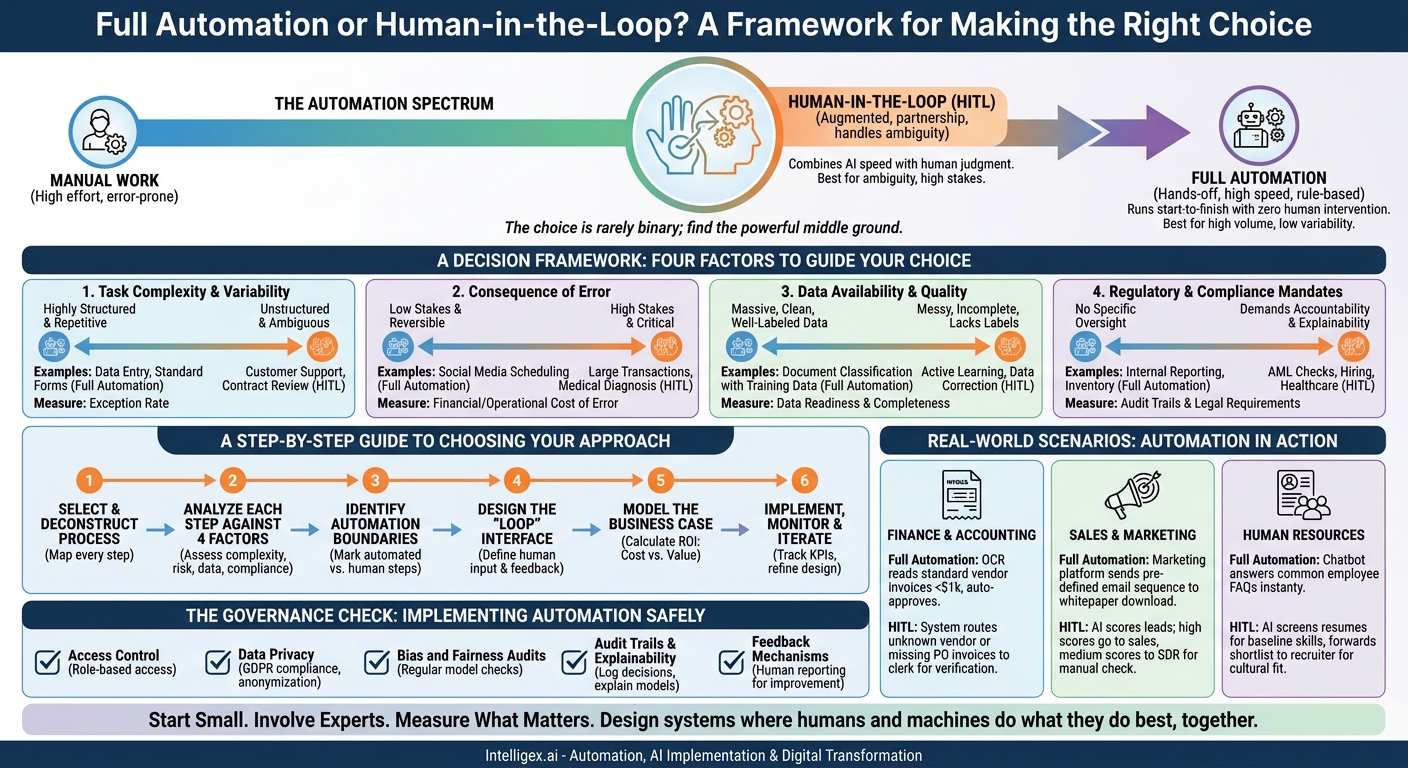
The push to automate is relentless. Every leader wants to unlock the promised benefits of artificial intelligence: lower costs, faster operations, and the ability to scale without limit. But the conversation around automation is often presented as a binary choice. You either automate a process completely, or you leave it as a manual task. This is a false and costly dichotomy. The most effective digital transformations recognize a powerful middle ground: Human-in-the-Loop (HITL) automation.
The critical question isn’t if you should automate, but how you should automate. Deciding where a process falls on the spectrum from manual work to full, lights-out automation is one of the most important strategic decisions you can make. Getting it right means creating efficient, resilient, and intelligent systems. Getting it wrong means building brittle processes that fail silently, frustrate employees, and introduce unacceptable risks. This guide provides a practical framework for making that decision, moving beyond the hype to focus on tangible business value.
Understanding the Automation Spectrum
Before you can choose the right path, you need a clear map of the territory. Automation isn’t a single destination. It’s a continuum of possibilities, with two primary models defining the ends of that spectrum.
Full Automation: The “Hands-Off” Engine
Full automation is exactly what it sounds like. A process runs from start to finish with zero human intervention. Once triggered, the system follows a predefined set of rules or an AI model’s logic to complete the task. This is the classic vision of robotic process automation (RPA) and AI-driven workflows.
- Best for: High-volume, low-variability tasks that are predictable and rule-based.
- Example: A finance department process that receives a standardized digital invoice, matches its line items against a purchase order in the ERP system, and, if everything matches perfectly, schedules the payment. This can happen thousands of times a day without a person ever seeing it.
- Primary Business Value: Unmatched speed and scalability. The marginal cost of processing one more item approaches zero. It frees up human teams from repetitive, mundane work to focus on higher-value analysis and strategy.
Human-in-the-Loop (HITL): The “Augmented” Approach
A Human-in-the-Loop system is a partnership between a person and an AI. The automated system does the heavy lifting. It ingests data, performs analysis, and prepares a recommendation or flags an issue. However, it requires a human to make the final judgment call, handle an exception, or provide a critical piece of nuanced input. The human acts as a combination of validator, problem-solver, and teacher.
- Best for: Tasks that are mostly automatable but involve ambiguity, high stakes, or a need for subjective judgment.
- Example: An insurance claims processing system uses AI to read a submitted claim, extract key details, and check them against policy rules. It can automatically approve simple, low-value claims. But if the claim is for a large amount or contains unusual language, the system flags it and routes it to a human claims adjuster with a pre-populated summary and a recommendation. The adjuster makes the final, critical decision.
- Primary Business Value: Quality and risk mitigation. HITL combines the speed and data-processing power of AI with the contextual understanding, ethics, and nuanced judgment of a human expert. It creates a powerful safety net that builds trust in automated systems.
A Decision Framework: Four Factors to Guide Your Choice
Choosing between these two models requires a clear-eyed assessment of the process itself. You can’t simply pick the most technologically advanced option. You must pick the one that best serves the business outcome. Use these four factors to analyze any task you’re considering for automation.
1. Task Complexity and Variability
This is the degree to which a task is predictable and follows a set pattern. Does the input data always look the same? Are the decision rules black and white?
- Lean toward Full Automation when: The process is highly structured and repetitive. Think of data entry from a single, standardized web form or synchronizing customer records between two systems with a clear unique identifier. The number of exceptions is near zero.
- Lean toward HITL when: The process involves unstructured data (like emails or contracts), requires context or common-sense reasoning, or has a wide range of possible outcomes. Categorizing customer support tickets is a classic example. An AI can handle common requests like “password reset,” but it needs a human to interpret a vague, frustrated email and determine the customer’s true intent.
- What to measure: Track the exception rate of your current or proposed automation. If an automated process consistently flags more than 5-10% of its workload for manual review, it may be a sign that a formal HITL design is a more honest and effective approach.
2. Consequence of Error
What happens when the automation gets it wrong? Is the result a minor inconvenience or a major catastrophe? The potential impact of a mistake is a critical determinant.
- Lean toward Full Automation when: The stakes are low. An error is easily reversible and has minimal financial, legal, or reputational impact. For example, if an automated social media scheduler posts at 9:05 AM instead of 9:00 AM, the consequences are negligible.
- Lean toward HITL when: The cost of an error is high. This includes scenarios involving large financial transactions, medical diagnoses, legal compliance, or critical customer interactions. An AI might suggest a credit line for a B2B customer based on its analysis, but you absolutely want a human credit analyst to make the final approval on a seven-figure limit.
- What to measure: Model the financial or operational cost of a single critical error. Compare that potential cost to the ongoing operational cost of having a human reviewer in the loop. The value of the human safety net often becomes very clear.
3. Data Availability and Quality
AI-powered automation is not magic. It is fueled by data. The quality and quantity of your data will directly limit your automation possibilities.
- Lean toward Full Automation when: You have access to a massive, clean, and well-labeled dataset to train a highly accurate AI model. For an AI to reliably classify documents on its own, for example, it needs to have been trained on thousands of examples of each document type.
- Lean toward HITL when: Your data is messy, incomplete, or lacks clear labels. In this common scenario, the HITL model becomes a powerful solution. The human doesn’t just validate decisions; they create new labeled data with every action they take. When a human corrects an AI’s miscategorization of an invoice, that correction can be fed back into the system to retrain and improve the model over time. This concept, known as active learning, turns a simple review process into a data-generation engine.
- What to measure: Assess your data readiness. Look at metrics like data completeness, the percentage of structured vs. unstructured data, and the availability of historical outcome labels.
4. Regulatory and Compliance Mandates
In many industries, you are not just accountable to your customers and shareholders. You are accountable to auditors and regulators. This often requires clear lines of human responsibility.
- Lean toward Full Automation when: The task has no specific regulatory oversight requiring human sign-off. Internal operational reporting or inventory management are often good candidates.
- Lean toward HITL when: The process is governed by regulations that demand accountability and explainability. Areas like financial anti-money laundering (AML) checks, HR hiring practices (to prevent bias), or healthcare record processing often legally or ethically require a human to be the final arbiter. An AI can flag a suspicious transaction, but a compliance officer must be the one to file a Suspicious Activity Report. This provides a clear audit trail and an accountable party. Regulations like Europe’s GDPR also place restrictions on purely automated decision-making that has significant effects on individuals.
A Step-by-Step Guide to Choosing Your Approach
Moving from theory to practice requires a structured process. Follow these steps to systematically evaluate a workflow and design the right automation strategy.
- Select and Deconstruct the Process. Choose a single, high-impact business process. Don’t try to boil the ocean. Map out every single step, decision point, and manual touchpoint in the current workflow. Be incredibly detailed.
- Analyze Each Step Against the Four Factors. Go through your map step-by-step. For each action, assess its complexity, the consequence of an error, its data requirements, and any compliance constraints. This isn’t about the process as a whole, but its component parts.
- Identify the Automation Boundaries. Based on your analysis, mark which steps are clear candidates for full automation (low risk, high structure) and which require human judgment (high risk, high ambiguity). The points where the process moves from automated to human and back again are your HITL interfaces.
- Design the “Loop” Interface. For steps requiring human input, define how the system will interact with the person. What information does the human need to see to make an informed decision? How will their decision be captured and fed back into the system? The goal is to present the human with a clear, concise task, not just dump raw data on them. For example, instead of showing a 100-page contract, the AI could highlight the three non-standard clauses it detected and ask for approval.
- Model the Business Case. Calculate the return on investment. For full automation, the cost is primarily development and maintenance. For HITL, it’s development plus the ongoing cost of the human’s time. Compare these to the baseline cost of the current manual process. Factor in the value of speed, improved quality, and risk reduction, which can often outweigh the simple labor cost savings.
- Implement, Monitor, and Iterate. Deploy your new automated or semi-automated process. Track key performance indicators (KPIs) relentlessly: processing time per item, error rates, human review time, and overall process cost. The data will tell you if your initial design was correct and will highlight opportunities for further improvement.
Real-World Scenarios: Automation in Action
Let’s see how this framework applies to common business functions.
In Finance and Accounting
- Full Automation: A system that uses Optical Character Recognition (OCR) to read vendor invoices. For invoices from known vendors that are below a $1,000 threshold and match an existing purchase order, the system automatically approves and queues them for payment.
- HITL: The same OCR system encounters an invoice from a new, unrecognized vendor, or an invoice that is missing a PO number. Instead of rejecting it, the system routes the digitized invoice and its extracted data to an accounts payable clerk’s dashboard. The clerk verifies the data, creates a new vendor record if needed, and approves the payment with a single click.
In Sales and Marketing
- Full Automation: A marketing automation platform like HubSpot or Salesforce Marketing Cloud sends a follow-up email sequence to a user who downloads a whitepaper. The sequence is entirely pre-defined and runs without intervention.
- HITL: A lead scoring AI analyzes inbound leads based on their firmographic data and website behavior. Leads scoring above 90 are flagged as “sales-ready” and automatically assigned to a sales representative. Leads scoring between 60 and 89 are routed to a junior sales development rep (SDR) who performs a quick manual qualification check before passing them to a senior rep. This prevents senior reps from wasting time on poorly qualified, AI-flagged leads.
In Human Resources
- Full Automation: An employee chatbot connected to the company’s knowledge base instantly answers common questions like “What is the policy for parental leave?” or “How many vacation days do I have left?”
- HITL: An AI-powered tool screens thousands of resumes for a software engineering position, checking for mandatory skills like “Python” and “AWS.” It forwards a shortlist of the top 50 candidates who meet the baseline criteria to a human recruiter. The recruiter then assesses for nuanced qualities like career progression, project experience, and potential cultural fit before deciding who to interview.
The Governance Check: Implementing Automation Safely
Speed and efficiency cannot come at the cost of responsibility. As you implement more sophisticated automation, especially systems involving AI and sensitive data, establishing a strong governance framework is not optional. It’s essential for building trust and managing risk.
Before deploying a new automated workflow, run through this simple checklist:
- Access Control: Is it clear who has the authority to view the data, modify the automation rules, or override an AI’s decision? Implement role-based access to ensure employees only see what they need to.
- Data Privacy: If the process touches customer or employee data, ensure it complies with privacy regulations like GDPR. This might involve anonymizing data used for training AI models or ensuring there’s a clear legal basis for the automated processing.
- Bias and Fairness Audits: AI models learn from historical data. If that data contains historical biases, the AI will learn and amplify them. Regularly audit your models, especially in sensitive areas like hiring or credit, to ensure they are producing fair and equitable outcomes.
- Audit Trails and Explainability: For any critical decision, you must be able to answer the question, “Why did this happen?” Log every automated step and every human decision. For AI-driven choices, aim to use models that can provide a reason for their recommendations. This is crucial for debugging, compliance, and building user trust.
- Feedback Mechanisms: Create a simple, clear process for the humans in the loop to report when the AI gets something wrong. This feedback is the single most valuable resource for improving your models over time.
From Here to Implementation: Your Next Steps
The journey to intelligent automation is an iterative one. It’s about making smart, incremental improvements, not searching for a single “big bang” solution. To get started, focus on a simple, actionable plan.
First, start small. Identify one process that is causing significant manual pain but is also well-understood by your team. A successful pilot project builds momentum and provides invaluable lessons for future, more complex initiatives.
Second, involve your experts. The people currently performing the manual task are the true subject matter experts. Bring them into the design process from day one. They understand the hidden exceptions and real-world complexities that a process map alone will never capture. Their involvement is the difference between a system that works in theory and one that works in practice.
Finally, measure what matters. Before you change anything, establish a clear baseline for the current process. How long does it take? What is the error rate? What is the cost per transaction? After you implement your new automated workflow, track these same metrics. Proving the value of automation with hard data is the best way to secure buy-in for your next project and build a culture of continuous improvement.
The choice is rarely just “human vs. machine.” The most successful organizations are learning to ask a better question: “How can we design systems where humans and machines do what they do best, together?”
Your Next Read:
Category:
Get a FREE
Proof of Concept
& Consultation
No Cost, No Commitment!
