

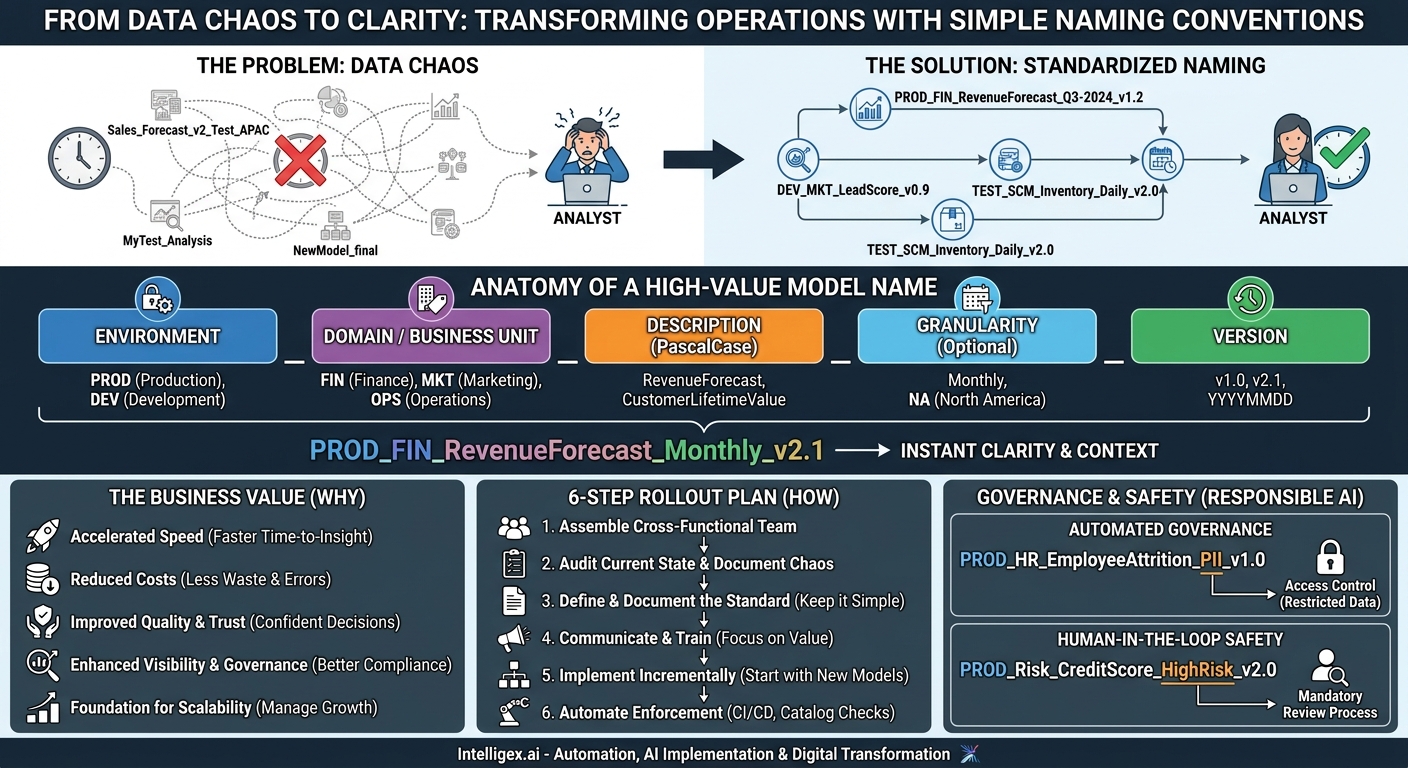
Your top analyst just spent two days preparing a critical sales forecast for the quarterly business review. The presentation is in an hour. Then, a message arrives: they used the wrong model. The analysis was based on Sales_Forecast_v2_Test_APAC, a development model with unverified data, not Sales_Forecast_PROD_Global_v3.1. The result is a frantic scramble, a delayed meeting, and a significant blow to the team’s credibility. This scenario, in various forms, plays out every day in organizations struggling with data chaos. The culprit is often a seemingly minor detail: the lack of a standardized model naming convention.
A disciplined approach to naming your data models, machine learning algorithms, and even simple analytical reports is not just an IT cleanup task. It is a foundational element of a high-performing, scalable analytics function. Implementing a clear and consistent naming system is one of the highest-leverage, lowest-cost improvements you can make to your data operations. It directly drives business value by improving the speed, cost, quality, and governance of your entire analytics ecosystem.
From Chaos to Clarity: The Business Case for Naming Conventions
Before diving into the “how,” it’s crucial to understand the “why.” A logical naming convention is an investment that pays continuous dividends across the organization by directly addressing common operational bottlenecks.
- Accelerated Speed: When a model’s name instantly tells you its purpose, status, and owner (e.g.,
PROD_FIN_RevenueForecast_Q3-2024_v1.2), analysts stop wasting time searching through ambiguous file names. They can find, validate, and use the right asset in minutes, not hours. This accelerates the entire “time-to-insight” cycle, meaning the business gets answers faster. Onboarding new team members also becomes significantly more efficient, as they can navigate the data landscape independently. - Reduced Costs: Wasted time is wasted money. Every hour a data scientist or business analyst spends deciphering cryptic model names or re-running analyses due to errors is a direct operational cost. Worse, decisions based on incorrect or outdated models can lead to costly strategic mistakes, such as misallocating marketing spend, over- or under-stocking inventory, or setting unrealistic sales targets.
- Improved Quality and Trust: Consistency breeds trust. When stakeholders know that all models in the
PRODenvironment have been vetted and approved, they have greater confidence in the analytics they consume. A clear convention eliminates the ambiguity that leads to multiple “versions of the truth” and reduces the reliance on untracked, “shadow IT” spreadsheets and models. - Enhanced Visibility and Governance: A structured name is a rich source of metadata. It simplifies data lineage tracking, making it easier to understand how data flows through your systems. For compliance and auditing purposes, this is invaluable. It becomes simple to identify all models related to a specific business unit (e.g., all models starting with
HR_) or those containing sensitive data, which is a critical requirement for regulations like GDPR. - Foundation for Scalability: An organization with ten models can survive on ad-hoc naming. An organization with a thousand cannot. As your use of data and AI matures, a systematic approach to asset management is non-negotiable. A naming convention provides the necessary structure to manage complexity and ensure that your analytics capabilities can grow with the business without collapsing under their own weight.
The Anatomy of a High-Value Model Name
A robust naming convention is descriptive, predictable, and easy for both humans and machines to parse. While the exact formula should be tailored to your organization, most successful conventions include a few core components, often separated by underscores or hyphens. Consider a template like this: [Environment]_[Domain]_[Description]_[Granularity]_[Version]
Component 1: Environment
This is the most critical element for operational safety. It clearly separates in-progress work from validated, production-ready assets.
- DEV: For models in active development, not to be used for business decisions.
- TEST: For models undergoing quality assurance and validation. Data is stable, but the model logic is being tested.
- PROD: Production models that are approved, validated, and power official reports, dashboards, or applications.
Example in action: Seeing PROD_ instantly tells a user that this model is safe to use for official business reporting.
Component 2: Business Unit or Domain
This component assigns clear ownership and context, helping users quickly find models relevant to their function.
- FIN: Finance
- MKT: Marketing
- OPS: Operations
- HR: Human Resources
- SCM: Supply Chain
Example in action: A supply chain planner can filter for all assets starting with SCM_ to find inventory and logistics models.
Component 3: Model Description
This is the human-readable part of the name. It should be concise but descriptive, written in PascalCase (FirstWordCaps) or snake_case (word_caps) for readability.
- Good:
CustomerLifetimeValue,LeadConversionScore,InventoryDemandForecast - Bad:
NewModel,Cust_Analysis_02,MyTest
Example in action: PROD_MKT_CustomerLifetimeValue... clearly communicates the model’s purpose.
Component 4: Granularity or Specifics (Optional)
For models that are segmented or run on a specific cadence, adding details on granularity prevents confusion. This can include geographic regions, product lines, or time intervals.
- Time:
Daily,Weekly,Monthly - Geography:
NA(North America),EMEA(Europe, Middle East, and Africa),US-West - Business Segment:
Enterprise,SMB(Small and Medium-sized Business)
Example in action: PROD_SCM_InventoryDemandForecast_Daily_NA... is far more specific than one without the granularity.
Component 5: Versioning
Versioning is essential for reproducibility and tracking performance over time. It allows you to roll back to a previous version if an issue is discovered.
- Semantic Versioning: Use
v1.0,v1.1,v2.0. A change in the last digit (patch) might be a bug fix, the middle digit (minor) a new feature, and the first digit (major) a significant logic overhaul. - Date Stamp: Use a
YYYYMMDDformat for models that are retrained and deployed on a regular schedule.
Putting it all together: A final, high-quality model name could be PROD_FIN_CashFlowProjection_Monthly_SMB_v2.1. You know instantly that this is the production-ready, finance-owned, version 2.1 cash flow projection for the SMB segment, updated monthly.
A 6-Step Rollout Plan for Your Naming Standard
Deploying a new standard requires more than just sending an email. A thoughtful implementation process ensures adoption and long-term success.
- Assemble a Cross-Functional Team: Do not create the standard in an IT silo. Form a small working group with representatives from the data team (analysts, scientists, engineers) and key business units that produce or consume data. This builds early buy-in and ensures the standard is practical for everyone.
- Audit the Current State: Before defining the future, understand the present. Conduct a quick audit of your 20-30 most critical models. Document their current names. This exercise will reveal the extent of the chaos and provide a powerful justification for the change.
- Define and Document the Standard: Using the components outlined above, draft version 1.0 of your naming convention. Keep it simple. Create a single, easy-to-read document with the rules and clear examples. Store this document in a central, accessible location like your company’s wiki or data catalog.
- Communicate and Train: Host brief training sessions to explain the new standard. Crucially, focus on the “why” (the business value) before the “what” (the syntax). Show teams how this will make their jobs easier. Make the documentation a required reading for all new hires in data-related roles.
- Implement Incrementally: Do not attempt to rename every existing asset overnight. This is disruptive and unnecessary. Start by mandating the convention for all new models. Then, prioritize renaming your most critical production models. Less-used, older models can be renamed over time or as they are updated.
- Automate Enforcement and Monitoring: A standard is only effective if it’s followed. Use automation to make compliance the path of least resistance. For example, configure your CI/CD pipelines to check for valid model names before deployment. Use data catalog tools to automatically flag non-compliant assets. This shifts the burden from manual policing to automated governance. This is a core concept in modern MLOps, with tools like MLflow enabling such automated tracking.
Common Pitfalls and How to Sidestep Them
Many well-intentioned efforts to standardize naming fail due to a few common mistakes. Being aware of them can help you navigate the process more effectively.
- The Overly Complex Standard: If your naming convention has ten components and requires a cheat sheet to understand, it will be ignored. Strive for a balance between descriptive detail and simplicity. Aim for a standard that a new employee can understand after a 15-minute introduction.
- The Top-Down Mandate: If the standard is perceived as a bureaucratic rule imposed by IT, it will be met with resistance. Involving business users in the creation process makes them partners in its success. Frame it as a collective improvement, not a mandate.
- The “Suggestions” Trap: A standard without any enforcement mechanism is merely a suggestion. While the goal isn’t to be punitive, gentle enforcement through automated checks and code reviews is essential to build and maintain the habit of compliance.
- Forgetting the Dictionary: The standard itself must be well-documented. What does the acronym “SCM” stand for? Which business unit owns “OPS”? This “data dictionary” for your naming convention should be easy to find and contribute to.
Governance and Safety: How Naming Supports Responsible AI
In an era of increasing automation and AI, model naming conventions become a critical first line of defense in responsible technology implementation. A name is more than a label; it’s a policy hook.
When a model is named PROD_HR_EmployeeAttritionRisk_PII_v1.0, the _HR_ and _PII_ (Personally Identifiable Information) tags are powerful signals. This clarity enables automated governance. You can configure access control systems to ensure that only authorized user groups, like specific HR managers, can access or execute models containing these tags. This is a simple yet effective way to enforce data privacy and need-to-know principles, a practice that mirrors asset management strategies seen in major cloud platforms. You can find more on this in documentation from providers like Amazon Web Services.
Furthermore, this naming clarity supports “human-in-the-loop” workflows. For high-stakes decisions, like those informed by an employee attrition model or a customer credit scoring model, the name itself can trigger a mandatory review process. An automated workflow can flag any action derived from a model marked as “HighRisk” for human approval before it is finalized, building a crucial safeguard against algorithmic bias and error.
Your Action Plan: Start Today
Transforming your model management from chaos to clarity doesn’t require a massive, multi-year project. You can start building momentum with small, tangible steps. Here is a simple plan to get started.
- This Week: Identify one key analyst and one business stakeholder who frequently deals with analytics. Schedule a 30-minute conversation to discuss the challenges of finding and trusting the right data models. Use their stories to build your case for change.
- This Month: Assemble your small, cross-functional working group. Your first task is to audit 10-15 of your most frequently used production models. Document their current names, owners, and purpose. This simple audit will provide a clear snapshot of the problem.
- This Quarter: Draft and agree upon version 1.0 of your naming convention. Don’t aim for perfection. Aim for a “good enough” standard that you can pilot with a single team on their next project. Gather feedback, iterate, and prepare for a broader rollout.
By taking these deliberate steps, you can begin to build a more reliable, efficient, and scalable analytics foundation. It starts not with a complex new technology, but with the simple, powerful act of agreeing on what to call things.
Your Next Read:
Category:
Get a FREE
Proof of Concept
& Consultation
No Cost, No Commitment!
