

Your business runs on data, but is your data architecture holding you back? Many organizations find themselves stuck with data processes that were built for a different era. They are slow, rigid, and expensive to maintain. When the marketing team needs to analyze campaign results, they have to wait a day for the data. When finance needs a new report, it becomes a multi-week IT project. This delay between a business question and a data-driven answer is a significant competitive disadvantage.
The problem often lies in a technology pattern known as traditional ETL (Extract, Transform, Load). For years, it was the standard for moving data into a centralized data warehouse for reporting. But as data volumes have exploded and the demand for real-time insights and advanced analytics has grown, its limitations have become painfully clear. A modern alternative, the Databricks Lakehouse Platform, offers a fundamentally different approach designed for the speed and scale today’s businesses require. This post breaks down the practical differences and provides a clear framework for deciding which path is right for you.
What is Traditional ETL and Why is it Stalling Your Business?
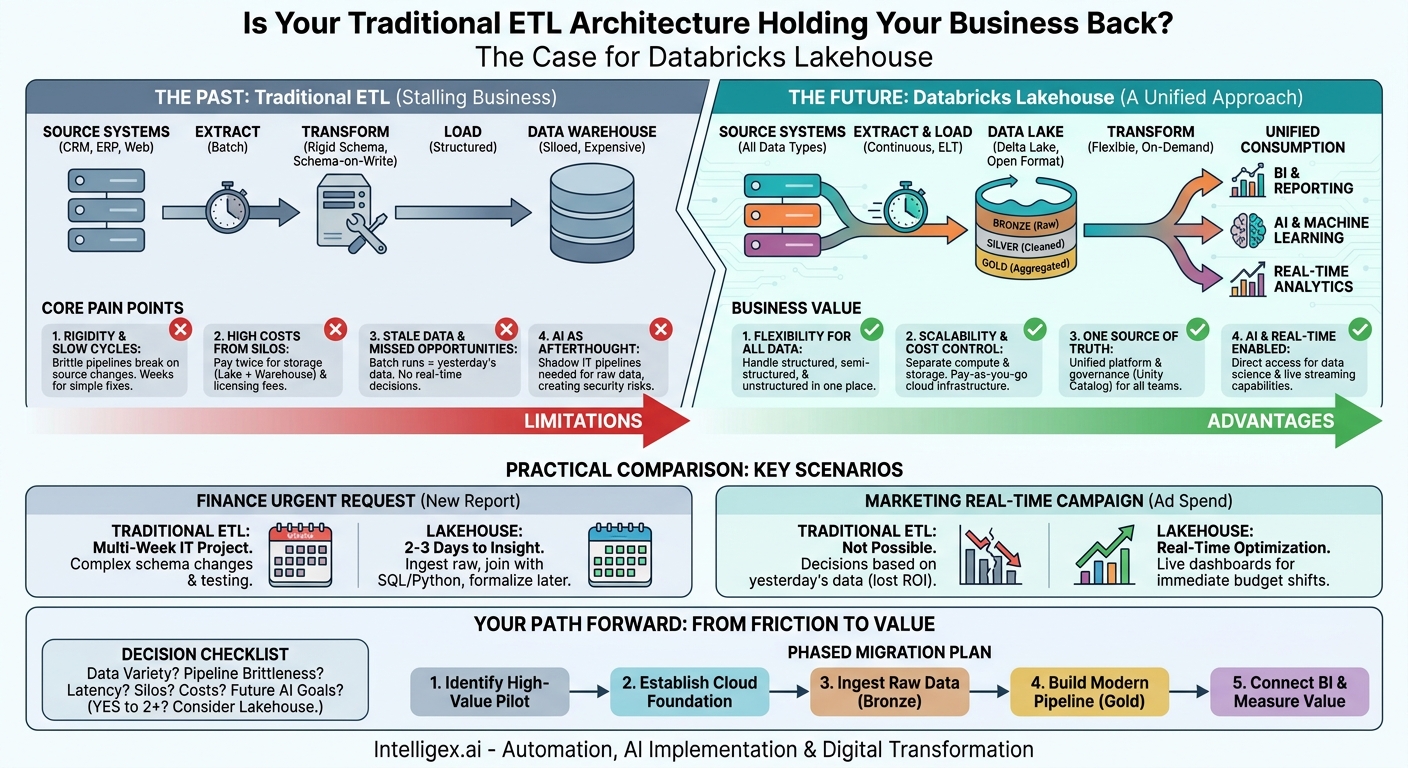
Traditional ETL is a linear, three-step process. First, data is extracted from source systems like your CRM, ERP, or web servers. Second, it is moved to a separate, specialized server where it is transformed. This means it is cleaned, reshaped, and forced into a predefined, rigid structure (a schema). Finally, this structured data is loaded into a corporate data warehouse for analysis by business intelligence (BI) tools.
While this process creates clean, reliable reports, it comes with significant business costs that are often hidden within IT budgets and project delays.
The Four Core Pain Points of Traditional ETL
1. Rigidity and Slow Change Cycles: Traditional ETL relies on a “schema-on-write” model. You must define the exact structure of your data before you can load it into the warehouse. If a source system changes, for example, your sales team adds a new custom field in Salesforce, the entire ETL pipeline breaks. Fixing it requires a developer to update the transformation logic, modify the data warehouse schema, and extensively test the entire process. A seemingly simple business request can turn into a month-long IT project.
2. High Costs from Siloed Systems: This architecture forces you to maintain at least two separate, expensive data systems. You have a data lake (like Amazon S3 or Azure Data Lake Storage) for storing raw, unstructured data, and a separate data warehouse for structured, analytics-ready data. You pay to store the data twice and you pay again to move it between the systems. On top of that, commercial ETL tools often come with hefty licensing fees that scale with data volume.
3. Stale Data and Missed Opportunities: Most traditional ETL jobs run in batches, typically once every 24 hours overnight. This means your business leaders are always making decisions based on yesterday’s information. For a supply chain manager tracking shipments or a marketing team optimizing digital ad spend, a 24-hour delay is an eternity. They cannot react to opportunities or threats in real time because the data simply isn’t available.
4. Data Science and AI are an Afterthought: Machine learning and AI models thrive on raw, granular data. A traditional data warehouse, by design, only stores aggregated, highly transformed data. This forces your data science team to bypass the warehouse entirely. They must request access to the raw data in the data lake, creating a separate, ungoverned “shadow IT” pipeline. This creates massive data silos, duplicates effort, and introduces serious security and compliance risks.
Enter the Databricks Lakehouse: A Unified Approach
Databricks flips the old model on its head with an architecture called the Lakehouse. The core idea is simple but powerful: combine the low-cost, scalable storage of a data lake with the performance and data management features of a data warehouse into a single, unified platform. It eliminates the need to maintain separate systems, reducing complexity and cost.
Instead of ETL, the Lakehouse uses an ELT (Extract, Load, Transform) approach. You extract raw data from your sources and load it directly into your open-format data lake, built on technologies like Delta Lake. Only then do you transform the data for specific use cases, whether it’s a BI dashboard, a machine learning model, or an exploratory analysis. This small change has massive implications for business agility.
The Business Value of a Unified Platform
- Flexibility for All Data: A Lakehouse can handle any type of data in one place. Your finance team can run SQL queries on structured transaction data while your product team analyzes semi-structured JSON logs from your application, all within the same environment.
- Scalability and Cost Control: Built on top of cloud infrastructure from providers like Amazon Web Services or Microsoft Azure, Databricks separates compute from storage. This means you can scale your processing power up for a heavy job and then scale it back down to zero, only paying for what you use. You aren’t paying for an always-on, massive data warehouse.
- One Source of Truth for Everyone: With Databricks, your BI analysts, data engineers, and data scientists all work on the same platform with the same data. This breaks down silos, improves collaboration, and ensures everyone is working from a single, governed source of truth. Governance is applied once, at the data layer, not in multiple downstream applications.
A Practical Comparison: Key Business Scenarios
Let’s move from theory to practice. How does this difference play out in day-to-day business operations? Here are a few common scenarios comparing the two approaches.
Scenario 1: The Finance Department’s Urgent Request
The Request: The CFO needs to understand how recent shipping delays are impacting product profitability. She needs a new report combining sales data from the ERP with logistics data from a third-party shipping provider’s API.
With Traditional ETL:
- IT receives the request and scopes the project.
- A developer builds a new script to extract data from the logistics API.
- The ETL transformation job must be heavily modified to join the new data with the ERP data.
- The data warehouse schema must be altered to accommodate the new fields.
- The entire pipeline undergoes a multi-day testing and validation cycle.
- Finally, the BI team can build the report on the newly available data.
Estimated Time to Insight: 2 to 4 weeks.
With Databricks:
- A data analyst ingests the raw logistics data directly into the Lakehouse (the “bronze” layer). This takes a few hours.
- The analyst uses a simple SQL or Python notebook to join the raw logistics data with the existing ERP data. They can immediately explore the data and provide initial findings to the CFO.
- The data engineering team formalizes this logic into a production-grade pipeline using a tool like Delta Live Tables, creating a reusable, governed “gold” table for all future profitability analysis.
Estimated Time to Insight: 2 to 3 days.
Scenario 2: The Marketing Team’s Real-Time Campaign
The Goal: An e-commerce company is launching a major flash sale. The marketing team needs to monitor ad performance and website activity in real time to shift budget towards the best-performing channels.
With Traditional ETL: This is simply not possible. The team gets a report the next morning showing what happened yesterday. They can see they wasted thousands of dollars on an underperforming ad campaign but are powerless to act in the moment. The opportunity is lost.
With Databricks: Using structured streaming, Databricks can ingest data from ad platforms and clickstream sources in near real-time. A live dashboard, updated every few minutes, shows marketing managers which campaigns are driving conversions. They can immediately pause failing ads and reallocate the budget to successful ones, maximizing the sale’s ROI.
The Decision Checklist: Is a Lakehouse Right for You?
This checklist can help you determine if the limitations of traditional ETL are creating significant friction in your business. Consider if your organization faces these challenges:
- Data Variety: Do you need to analyze a mix of structured data (like financial records) and semi-structured or unstructured data (like customer service chat logs, social media comments, or images)?
- Pipeline Brittleness: Is your data engineering team constantly firefighting and fixing broken ETL jobs instead of building new data products?
- Data Latency: Do your business teams frequently complain that data is too old to be useful for operational decisions?
- Analytics Silos: Do your data science and BI teams work in completely separate environments, with duplicated data and inconsistent logic?
- Escalating Costs: Are your data warehouse and ETL licensing costs growing unpredictably as your data volumes increase?
- Future Ambitions: Do your strategic goals include implementing real-time analytics, predictive AI, or machine learning capabilities?
If you answered “yes” to two or more of these questions, it is highly likely that your traditional architecture is actively hindering your growth and a modern Lakehouse approach could provide significant value.
Making the Switch: A Phased Migration Plan
Migrating your entire data infrastructure is a daunting thought. The key is to avoid a “big bang” approach. Instead, pursue a phased migration that delivers business value at every step. This builds momentum and de-risks the process.
- Identify a High-Value Pilot Project. Don’t try to migrate everything at once. Select a single, critical business process that is clearly suffering from data friction. A good candidate is often a report or dashboard that is notoriously slow, frequently inaccurate, or requires significant manual effort to produce. For example, a weekly sales forecast that takes two employees three days to compile.
- Establish the Cloud Foundation. Set up your core infrastructure. This involves configuring your cloud storage (e.g., S3 or ADLS) and your Databricks workspace. From the very beginning, focus on establishing security best practices, identity management, and network controls.
- Ingest Raw Data for the Pilot. Use Databricks’ ingestion tools to pull the necessary raw data from the source systems for your pilot project. Load this data, as-is, into Delta Lake tables. This becomes your reliable, auditable “bronze” layer.
- Build Your First Modern Pipeline. Create a new data transformation pipeline using Databricks notebooks or Delta Live Tables. This pipeline will read from the bronze tables, then clean, validate, and aggregate the data into business-ready “gold” tables. This is where you replace the logic from your old, slow ETL job.
- Connect BI and Measure the Value. Point your existing BI tool (like Tableau or Power BI) to the new gold tables in Databricks. Work with the business users to validate the new dashboard. Now, measure the improvement. How much faster is the report generated? How much manual effort was eliminated? What is the reduction in compute cost? Quantifying this first win is crucial for getting buy-in for the next phase.
A Note on Governance and Safe Implementation
A modern data platform offers incredible power, but it must be implemented responsibly. Moving fast does not mean breaking things, especially when it comes to sensitive data. A key advantage of a platform like Databricks is its centralized governance framework, Unity Catalog.
Implement Role-Based Access Control (RBAC): From day one, define access policies based on user roles, not individuals. A financial analyst should only have access to the finance-related data tables, not sensitive HR or customer PII. Unity Catalog allows you to grant permissions on specific tables, rows, and even columns, ensuring a “least privilege” access model.
Automate Data Quality Monitoring: Prevent a “garbage in, garbage out” problem. Use Delta Live Tables to define “expectations” for your data, for example, a customer ID field should never be null, or a product price must be greater than zero. The system can automatically quarantine or flag bad data that violates these rules, preventing it from corrupting your analytics.
Keep a Human in the Loop for AI: When you graduate to building predictive models, ensure there is a clear process for human review. An AI model that predicts customer churn or flags fraudulent transactions should serve as a recommendation to a human operator, not an autonomous decision-maker. This is essential for fairness, accountability, and building trust in your AI initiatives.
Your Next Steps: From Comparison to Action
Understanding the difference between traditional ETL and a modern Lakehouse is the first step. Translating that knowledge into action is what drives business value. Here is a simple plan to get started.
- Audit Your Current Data Pains. Sit down with your business and IT teams and identify the top three data pipelines that are the most expensive to maintain, the most brittle, or deliver the most delayed data. Quantify the business impact in terms of hours wasted or opportunities missed.
- Calculate the Cost of Stale Data. Interview your sales, marketing, and operations leaders. Ask them what they could do differently if they had access to key operational data in near real-time instead of waiting 24 hours. The answer often reveals significant untapped value.
- Plan a Proof-of-Value. Don’t start with a “migration project.” Start with a “business value project.” Choose one of the pain points you identified and engage a partner to help you map out a small, focused proof-of-value on a modern platform. Demonstrating a clear win on a single, high-impact use case is the fastest way to build the momentum needed for true data-driven transformation.