

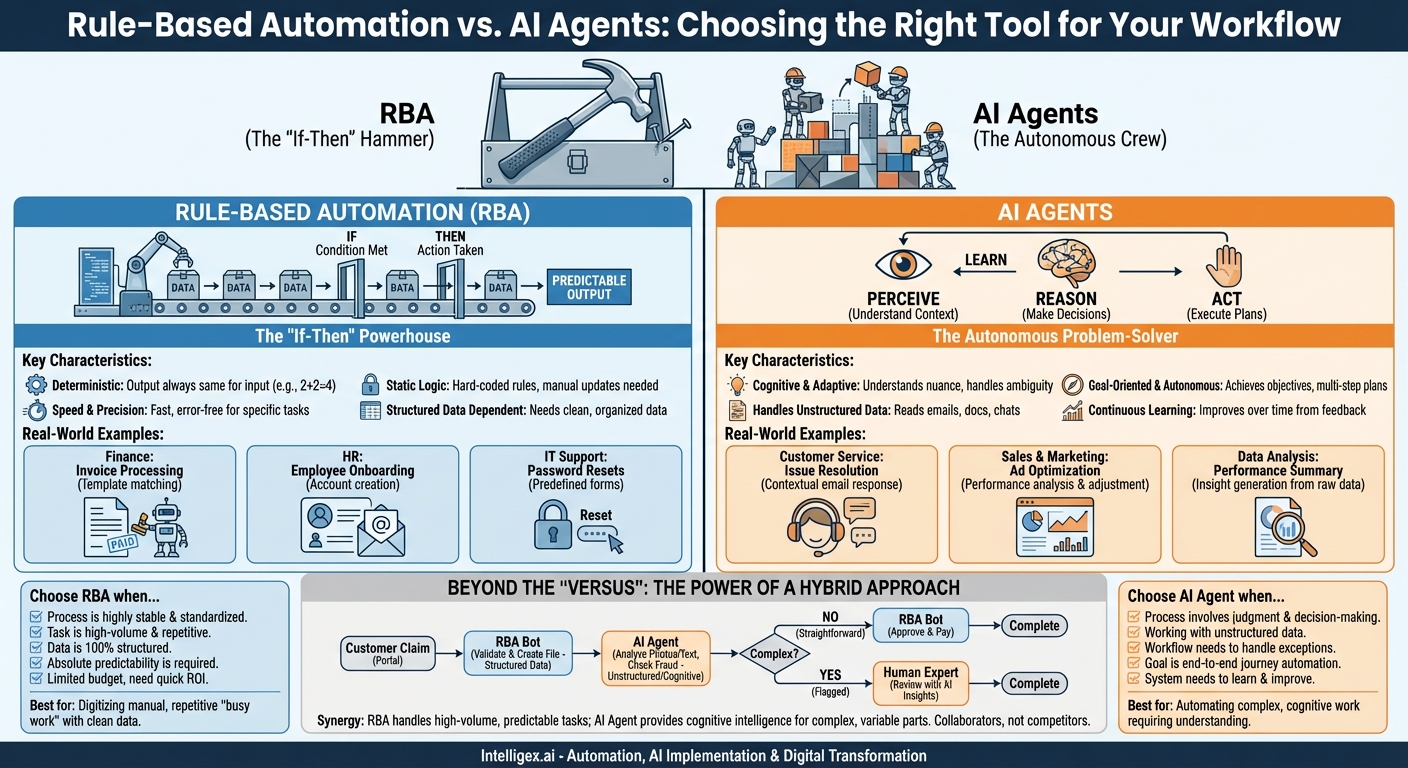
In the relentless pursuit of efficiency, businesses are turning to automation like never before. The promise is alluring: streamlined workflows, reduced human error, and freed-up teams to focus on high-value, strategic work. But as you venture into this landscape, you’ll quickly encounter a critical fork in the road, presented by two powerful but fundamentally different approaches: Rule-Based Automation and AI Agents. Choosing the wrong path can lead to frustrating implementations, brittle systems, and wasted investment. Choosing the right one can unlock unprecedented levels of productivity and intelligence.
The core of the issue isn’t about which technology is “better,” but which is the right tool for the job at hand. Think of it like building a house. You wouldn’t use a sledgehammer to drive a finishing nail, nor would you use a tiny tack hammer to demolish a wall. Rule-Based Automation is your precise, reliable, and powerful hammer for specific, repetitive tasks. AI Agents are your multi-skilled, autonomous construction crew, capable of assessing a complex situation, choosing the right tools, and executing a multi-step plan to build something new. Understanding the distinction is the first step toward building a truly effective automation strategy.
What is Rule-Based Automation? The “If-Then” Powerhouse
Rule-Based Automation (RBA), often associated with Robotic Process Automation (RPA), is the bedrock of traditional automation. Its logic is beautifully simple and transparent, operating on a strict set of pre-defined instructions. At its heart, RBA is a system built on “if-then-else” statements. If a specific condition is met, then the system performs a designated action. It’s a digital assembly line, executing a sequence of steps exactly as programmed, every single time.
This type of automation excels in environments that are stable, predictable, and reliant on structured data. Structured data is information that is highly organized and formatted, like the cells in a spreadsheet, fields in a database, or inputs on a web form. RBA bots are trained to navigate user interfaces, copy and paste data, open files, and perform calculations based on a script that a human has explicitly created.
Key Characteristics of Rule-Based Automation:
- Deterministic: The output is always the same for a given input. There’s no ambiguity or interpretation. 2 + 2 will always equal 4.
- Static Logic: The rules are hard-coded. The system does not learn or adapt on its own. If the process changes—for example, a button on a website moves or a form field is added—the script must be manually updated by a developer.
- Speed and Precision: For the tasks it’s designed for, RBA is incredibly fast and virtually error-free, working 24/7 without fatigue.
- Structured Data Dependent: It requires clean, predictable data sources. It struggles immensely with variations, typos, or unstructured information like the body of an email or a scanned PDF document.
Real-World Examples of RBA:
You’ll find RBA driving efficiency in countless back-office operations:
- Finance: An RBA bot can process invoices by extracting data from a specific template (Vendor Name, Invoice #, Amount), matching it against a purchase order in a database, and, if all the rules match, scheduling the payment in the accounting system.
- Human Resources: During employee onboarding, a bot can take information from a new hire form, create user accounts in multiple systems (email, CRM, HRIS), and send out a standardized welcome email.
- IT Support: A common use case is password resets. If a user fills out a “forgot password” form and correctly answers predefined security questions, a bot can automatically trigger the password reset link without human intervention.
The power of RBA lies in its reliability and straightforward ROI for high-volume, repetitive tasks. However, its rigidity is also its greatest weakness. When it encounters an exception—an invoice in a new format, a form with a missing field—it either fails or requires human help, breaking the automation chain.
Enter the AI Agent: The Autonomous Problem-Solver
If RBA is the assembly line worker, the AI Agent is the floor supervisor who can manage multiple lines, solve unexpected problems, and optimize the entire process. An AI Agent is a far more sophisticated entity, powered by artificial intelligence, particularly large language models (LLMs) and machine learning. It moves beyond simple “if-then” instructions to a cycle of perceive, reason, and act.
An AI Agent is given a goal, not just a script. It can understand context, interpret unstructured data, make decisions under uncertainty, and execute complex, multi-step actions across various applications to achieve its objective. It learns from its interactions and outcomes, becoming more effective over time.
Key Characteristics of AI Agents:
- Cognitive and Adaptive: They can understand natural language, sentiment, and intent. They can reason through ambiguity and handle variations in data and processes.
- Goal-Oriented and Autonomous: You can task an agent with “Resolve this customer’s shipping issue” instead of programming every single click. The agent will then figure out the necessary steps: read the email, look up the order in the CRM, check the tracking status with the carrier, and draft a personalized response.
- Handles Unstructured Data: This is their superpower. AI Agents can read and comprehend emails, support tickets, legal documents, customer reviews, and conversation transcripts, extracting relevant information and intent.
- Continuous Learning: Through feedback loops and exposure to new data, AI Agents can improve their performance, refine their decision-making processes, and adapt to changing business environments without constant reprogramming.
Real-World Examples of AI Agents:
AI Agents are tackling complex, front-office tasks that were once considered impossible to automate:
- Customer Service: An agent receives a customer email saying, “My recent order arrived with a cracked screen.” The agent understands the problem, pulls up the customer’s order history, confirms the warranty status, initiates a return process, orders a replacement, and drafts an empathetic email to the customer explaining the next steps—all in a matter of seconds.
- Sales and Marketing: A marketing agent could be tasked with “Optimize ad spend for the new product launch.” It would analyze performance data from Google Ads and Meta, identify underperforming creative, pause those campaigns, reallocate the budget to high-performers, and even use generative AI to suggest new ad copy variations based on what’s resonating with the audience.
- Data Analysis: A business analyst can ask an AI agent to “Summarize our Q3 sales performance in the Northeast region and highlight any anomalies compared to last year.” The agent would connect to databases, process the data, perform the comparative analysis, and generate a concise, natural-language report complete with key insights.
The trade-off for this immense power is increased complexity and cost in implementation. They require access to quality data, and their non-deterministic nature means their actions can sometimes be less predictable than a simple RBA bot, requiring robust monitoring and governance.
Making the Right Choice: Your Automation Playbook
So, how do you decide which path to take? The decision hinges on the nature of the task you want to automate. Ask yourself the following questions about your process.
Choose Rule-Based Automation when…
- The process is highly stable and standardized. It follows the same steps every time and rarely changes.
- The task is high-volume and repetitive. Think data entry, report generation, or file transfers.
- The data is 100% structured. You are working exclusively with databases, spreadsheets, or fixed-format forms.
- You require absolute predictability and auditability. Every step must be traceable and the outcome must be identical every time.
- Your budget is limited, and you need a quick, clear ROI. RBA projects are typically faster and cheaper to implement for simple tasks.
In short: Use RBA for digitizing manual, repetitive “busy work” that operates on clean data.
Choose an AI Agent when…
- The process involves judgment and decision-making. Tasks that require a human to “read, understand, and decide” are prime candidates.
- You are working with unstructured data. The core of the task involves processing emails, documents, chats, or images.
- The workflow needs to handle exceptions and variations gracefully. The system must be resilient to unexpected inputs and scenarios.
- The goal is to automate an end-to-end customer or employee journey, not just a single, discrete task.
- You want a system that learns and improves over time, adapting to new information and user feedback.
In short: Use AI Agents for automating complex, cognitive work that requires understanding context and making intelligent choices.
Beyond the “Versus”: The Power of a Hybrid Approach
The most sophisticated and effective automation strategies rarely treat this as an either/or decision. The true future of automation lies in the synergy between RBA and AI Agents, where each plays to its strengths in a single, seamless workflow.
Imagine an insurance claims processing workflow:
- A customer submits a claim through an online portal. An RBA bot takes this structured data, validates that all fields are complete, and creates a new claim file in the core system. (Fast, reliable, structured data handling).
- The customer also uploads photos of the damage and a written description of the incident. An AI Agent is now triggered. It analyzes the photos to classify the type and severity of damage and reads the customer’s description to understand the context and sentiment. (Unstructured data processing, cognitive analysis).
- The AI Agent then cross-references this information with the customer’s policy details and a knowledge base of historical claims to check for potential fraud indicators and suggest a preliminary settlement range. (Complex reasoning and decision-making).
- If the claim is straightforward, it’s passed to another RBA bot that generates the approval documents and initiates the payment process. If the AI agent flags it as complex or potentially fraudulent, it is automatically routed to a specialized human agent for review, complete with the AI’s summary and recommendation. (Orchestration and hand-off).
In this hybrid model, RBA handles the high-volume, predictable, administrative tasks with maximum efficiency, while the AI Agent provides the cognitive intelligence needed to handle the complex, variable, and data-rich parts of the process. It’s the best of both worlds: the raw power of the assembly line combined with the intelligent oversight of the expert supervisor.
The Right Tool for the Right Job
The debate over AI Agents vs. Rule-Based Automation is ultimately a false dichotomy. They are not competitors but collaborators on the automation spectrum. RBA is the foundational layer, a powerful tool for wringing inefficiency out of stable, repetitive processes. AI Agents are the transformative layer, bringing autonomy and intelligence to automate workflows previously thought to be beyond the reach of machines.
By carefully analyzing your business processes, understanding the nature of your data, and defining your strategic goals, you can move beyond the hype. You can start building a practical, powerful automation engine that leverages the steadfast reliability of rules and the dynamic intelligence of AI, creating a business that is not just faster, but fundamentally smarter.
Your Next Read:
Category:
Get a FREE
Proof of Concept
& Consultation
No Cost, No Commitment!