

In today’s business landscape, “digital transformation” is more than just a buzzword; it’s a fundamental imperative for survival and growth. Yet, for many organizations, the path is unclear. It’s a vast, often intimidating journey, and without a map, it’s easy to get lost. Companies invest in new technologies without a clear strategy, launch isolated digital projects that fail to scale, and struggle to align their entire organization around a common vision. How do you measure progress? How do you know what the next step should be? This is where a Digital Transformation Maturity Model becomes an indispensable tool.
Think of it as a GPS for your organization’s digital journey. It provides a structured framework to assess your current capabilities, identify gaps, and plot a clear, actionable course toward a more digitally advanced future. By understanding the distinct stages of maturity, you can move from scattered, reactive efforts to a cohesive, proactive strategy that embeds digital into the very DNA of your business. This post will break down the five common levels of digital transformation maturity, helping you pinpoint where your organization stands today and what it takes to climb to the next level.
What is a Digital Transformation Maturity Model?
At its core, a Digital Transformation Maturity Model is a diagnostic framework that evaluates an organization’s proficiency across several key dimensions. While the specifics can vary, these dimensions typically include:
- Strategy & Leadership: Is there a clear, communicated vision for digital transformation, driven from the top?
- Customer Experience: How deeply does the organization understand and leverage digital to serve its customers?
- Culture & People: Is the workforce equipped with the skills, mindset, and collaborative tools to thrive in a digital environment?
- Technology & Infrastructure: Is the tech stack modern, integrated, and agile enough to support digital initiatives?
- Data & Analytics: How effectively is data collected, analyzed, and used to drive decision-making and innovation?
By assessing performance in these areas, the model categorizes an organization into one of five levels. This categorization isn’t a judgment; it’s a vital starting point. It provides a common language for stakeholders, highlights critical areas for investment, and transforms a vague goal (“become more digital”) into a series of concrete, manageable steps. Now, let’s explore those five levels in detail.
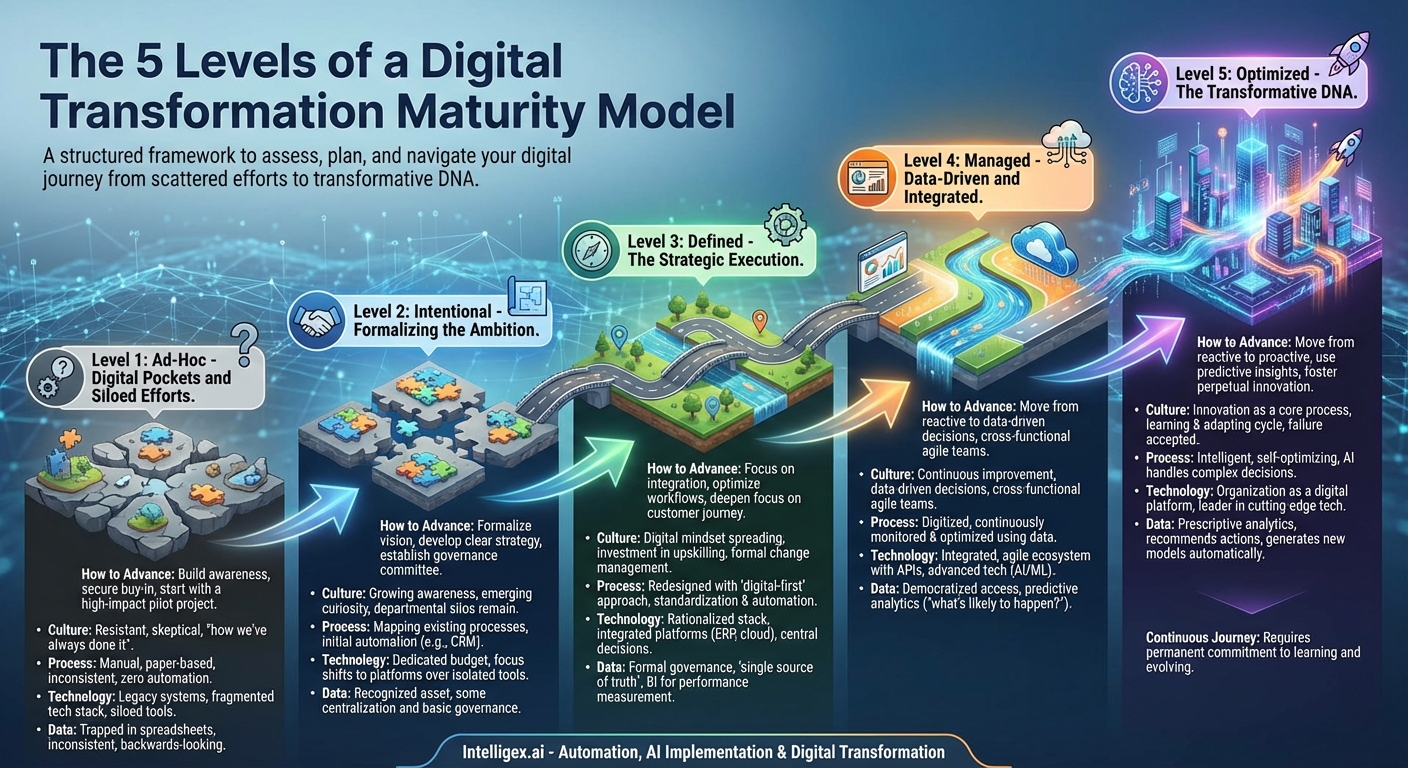
Level 1: Ad-Hoc – Digital Pockets and Siloed Efforts
Organizations at the Ad-Hoc level are just beginning to dip their toes into the digital water. There is no overarching strategy. Instead, digital initiatives are sporadic, experimental, and often driven by individual “digital champions” or single departments responding to a specific, isolated problem. These efforts are disconnected from one another and from the broader business objectives.
What it looks like:
- Culture: There’s a general resistance to change and a high degree of skepticism toward new technologies. The prevailing mindset is, “This is how we’ve always done things.” Digital skills are scarce and confined to a few individuals.
- Process: Workflows are predominantly manual, paper-based, and inefficient. There is little to no automation, and processes vary wildly between teams.
- Technology: The IT landscape is dominated by legacy systems that don’t communicate with each other. New tools are acquired on a departmental basis without consideration for integration, leading to a fragmented and costly tech stack.
- Data: Data is trapped in silos (spreadsheets, departmental databases) and is often inconsistent, inaccurate, or untrusted. Its use is limited to basic, backward-looking operational reporting.
Key Challenges: Lack of leadership vision, no dedicated budget for transformation, cultural inertia, and a fundamental fear of the unknown.
How to Advance: The primary goal is to build awareness and secure executive buy-in. Start by identifying a small, high-impact pilot project that can demonstrate tangible value. Use this “quick win” to build momentum and make the case for a more formal, strategic approach.
Level 2: Intentional – Formalizing the Ambition
At Level 2, the organization recognizes the need for a more structured approach. Leadership has acknowledged that digital transformation is important, and discussions about a formal strategy have begun. While efforts are still largely project-based and may not be fully integrated, there’s a conscious effort to coordinate and learn from them. The “why” behind digital is starting to be understood, even if the “how” is still being figured out.
What it looks like:
- Culture: Awareness is growing. More employees are open to experimentation, and there’s an emerging curiosity about digital tools and methods. However, collaboration between departments remains a significant challenge.
- Process: The organization begins to map out existing processes and identify key areas for digital improvement. Some initial automation projects may be underway, such as implementing a CRM or a new marketing automation platform.
- Technology: There is a more intentional investment in technology. A dedicated budget may be allocated for digital projects. The focus shifts from acquiring disparate tools to thinking about platforms that can serve multiple functions.
- Data: The organization starts to recognize data as a valuable asset. Efforts are made to centralize some data sources and establish basic governance. Analytics move beyond simple reporting to more diagnostic questions, like “Why did this happen?”
Key Challenges: Moving from isolated projects to a cohesive program, breaking down departmental silos, securing consistent funding, and developing a clear, enterprise-wide digital strategy.
How to Advance: The crucial step is to formalize the vision. Develop a clear digital transformation strategy with defined goals, metrics, and a roadmap. Establish a cross-functional governance committee or a dedicated transformation office to oversee and coordinate initiatives across the company.
Level 3: Defined – The Strategic Execution
This is a major turning point. At the Defined level, digital transformation is no longer a series of projects; it’s a formal, enterprise-wide program with clear leadership, governance, and funding. The strategy developed in Level 2 is now being actively executed and managed. The organization has a roadmap and is systematically working through it, scaling successful pilots and standardizing new digital processes across business units.
What it looks like:
- Culture: The digital mindset is becoming more widespread. The organization actively invests in upskilling and reskilling its workforce. Collaboration is not just encouraged but enabled through shared digital platforms. Change management is a formal part of the process.
- Process: Key business processes are being redesigned and optimized with a “digital-first” approach. Standardization and automation are priorities. The focus is on creating seamless workflows that improve both employee and customer experiences.
- Technology: The company is rationalizing its technology stack, decommissioning legacy systems, and investing in integrated, scalable platforms (e.g., ERP, cloud infrastructure). Technology decisions are made centrally based on the overarching digital strategy.
- Data: A formal data governance framework is in place. The organization has established a “single source of truth” for key data domains. Business intelligence and analytics are used strategically to inform decisions and measure the performance of digital initiatives.
Key Challenges: Managing the complexity of large-scale change, ensuring adoption of new systems and processes, and maintaining momentum as the initial “low-hanging fruit” projects are completed.
How to Advance: Focus on integration and optimization. Ensure that new digital capabilities are not just implemented but are fully integrated into the fabric of daily operations. Begin to focus more deeply on the customer journey, using data to personalize and improve every touchpoint.
Level 4: Managed – Data-Driven and Integrated
At Level 4, digital is no longer a separate initiative; it’s deeply woven into the way the business operates. The organization is now data-driven. Decisions at all levels are informed by real-time analytics and insights, not just gut feelings or historical precedent. The focus shifts from implementing technology to leveraging it for strategic advantage, primarily by creating a seamless and personalized customer experience.
What it looks like:
- Culture: A culture of continuous improvement and data-driven decision-making is embedded. Cross-functional teams are the norm, working in agile ways to respond quickly to market changes and customer needs. Innovation is encouraged at all levels.
- Process: Processes are not only digitized but are continuously monitored and optimized using data. The organization can quantify the impact of digital changes on business outcomes like efficiency, customer satisfaction, and revenue.
- Technology: The technology ecosystem is integrated, agile, and scalable. APIs connect systems seamlessly, enabling a holistic view of the customer and the business. The organization leverages advanced technologies like AI and machine learning for predictive insights.
- Data: Data is democratized. Employees across the organization have access to the data and tools they need to perform their roles effectively. Analytics become predictive, answering questions like, “What is likely to happen next?” and “What is the best course of action?”
Key Challenges: Avoiding complacency, keeping pace with the rapid evolution of technology, and protecting against new cybersecurity threats that emerge with increased digital integration.
How to Advance: The goal is to move from being reactive to proactive. Use predictive analytics to anticipate customer needs and market shifts. Foster a culture of perpetual innovation to explore new digital business models and revenue streams.
Level 5: Optimized – The Transformative DNA
This is the pinnacle of digital maturity. For an organization at Level 5, digital is not something they do; it is what they are. It is fully integrated into the business model, culture, and operations. The organization is a living, breathing digital ecosystem that is highly adaptive, innovative, and resilient. It doesn’t just respond to market disruption; it often is the disruptor, constantly reinventing itself and setting new standards for its industry.
What it looks like:
- Culture: Innovation is a core business process. The entire organization is aligned around a cycle of learning, experimenting, and adapting. Failure is accepted as a necessary part of the innovation process.
- Process: Business processes are intelligent and self-optimizing. AI and automation handle not just routine tasks but also complex decision-making, freeing up humans to focus on high-value strategic work.
- Technology: The organization operates as a true digital platform, potentially creating new business models by offering its technology or data as a service. It is a leader in adopting and integrating cutting-edge technologies.
- Data: Analytics are prescriptive, not only predicting the future but also recommending specific actions to achieve desired outcomes. Data is used to generate new products, services, and business models automatically.
Key Challenges: Sustaining a leadership position, fighting off new digital-native competitors, and managing the ethical implications of advanced AI and data usage.
The journey to Level 5 is continuous. It requires a permanent commitment to learning and evolving.
Conclusion: Your Journey Starts with a Single Step
The Digital Transformation Maturity Model is not about a race to Level 5. Not every organization needs to become a market-disrupting digital powerhouse. The true value of the model lies in its ability to provide clarity. It helps you have an honest conversation about where you are, define a realistic and ambitious vision for where you want to go, and build a practical roadmap to get there.
By understanding these five levels, you can move beyond the hype and begin the real, tangible work of transformation. The journey is long and challenging, but with a clear map in hand, you can navigate the complexities with confidence, ensuring that every investment, every project, and every effort moves you closer to your ultimate digital future.
Your Next Read:
Category:
Get a FREE
Proof of Concept
& Consultation
No Cost, No Commitment!