

In the not-so-distant past, the rhythm of business was the steady, predictable hum of human activity. It was the sound of keyboards clacking during manual data entry, the rustle of paper as invoices were physically filed, and the murmur of teams coordinating complex, multi-step processes through a series of emails and phone calls. This was the era of manual operations, a time when growth was directly proportional to headcount and the phrase “human error” was an accepted cost of doing business. But a quiet revolution has been reshaping the operational landscape, creating a stark and compelling contrast: the world before automation, and the world after.
To truly grasp the magnitude of this shift, we need to step back and examine the gritty reality of a business run on manual power. It’s a picture many of us know all too well.
The “Before” Picture: The World of Manual Operations
Imagine a business as a complex machine. In a manual environment, every gear, lever, and belt is moved by human hands. While admirable in its effort, this approach is inherently fraught with limitations that create a ceiling on efficiency, growth, and even employee satisfaction.
Time-Consuming and Labor-Intensive
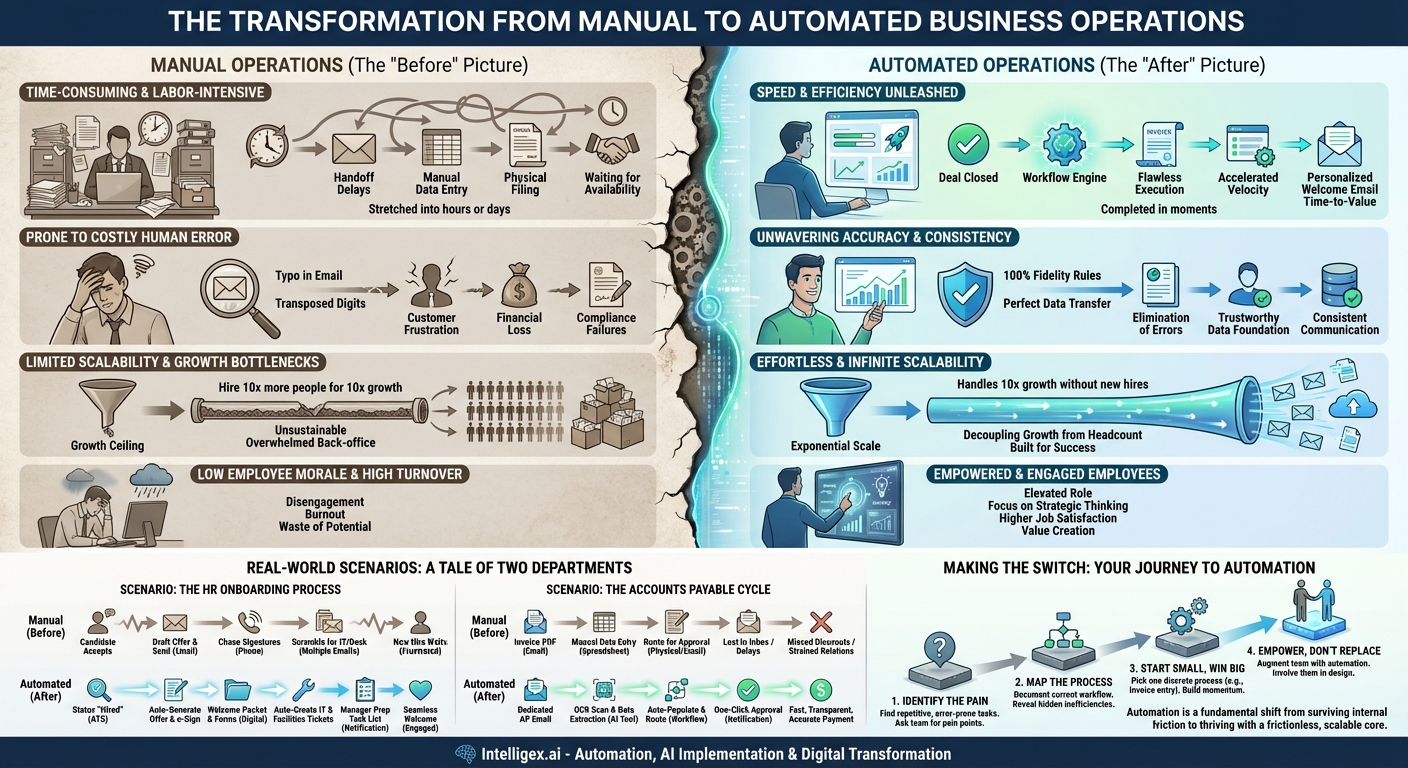
The most immediate and obvious characteristic of manual operations is the sheer amount of time they consume. Consider the process of onboarding a new client. A salesperson closes a deal and then begins a chain of manual handoffs. An email is sent to the finance department with contract details. Someone in finance manually creates an invoice in the accounting system. Another email goes to the project management team, where a manager manually sets up a project in their software. A welcome packet is manually assembled and emailed to the client. Each step involves a person, a pause, and the potential for delay. A process that could take minutes is stretched into hours or even days, entirely dependent on human availability and workload.
Prone to Costly Human Error
To err is human, but in business operations, errors are expensive. When an employee is transferring customer data from a web form into a CRM, a single typo in an email address can derail all future communications. When an accountant is manually consolidating numbers from ten different spreadsheets for a month-end report, transposing two digits can lead to flawed strategic decisions. These aren’t just hypotheticals; they are daily occurrences in manually-run organizations. The consequences ripple outwards, causing everything from customer frustration and brand damage to compliance failures and direct financial loss. The time spent finding and fixing these errors is an additional, hidden tax on productivity.
Limited Scalability and Growth Bottlenecks
How does a manual business handle a sudden 10x increase in orders? The only answer is to hire 10x more people—a solution that is slow, expensive, and often unsustainable. Manual processes create a direct link between volume and labor, meaning you can’t grow your output without proportionally growing your payroll. This creates a bottleneck. The very success a company strives for becomes a threat to its operational stability. The back-office teams—finance, HR, operations—become overwhelmed, service quality drops, and the business hits a growth ceiling, unable to expand without breaking its own internal processes.
Low Employee Morale and High Turnover
What is the human cost of manual work? Employees hired for their intelligence, creativity, and problem-solving skills find themselves mired in repetitive, mind-numbing tasks: copying and pasting data, cross-referencing spreadsheets, sending template emails. This is a recipe for disengagement and burnout. Talented individuals feel their potential is being wasted on work a machine could do. This leads to low morale, decreased motivation, and ultimately, higher employee turnover as people seek more fulfilling roles where they can make a genuine impact.
The “After” Picture: The Transformation with Automated Operations
Now, let’s repaint the picture. The business is still a complex machine, but now it’s equipped with a sophisticated, self-regulating engine. Automation takes the repetitive, rule-based tasks and executes them flawlessly, freeing the human team to serve as skilled pilots and navigators, focusing on strategy, innovation, and handling complex exceptions.
Speed and Efficiency Unleashed
That same client onboarding process that took days is now completed in moments. The instant a deal is marked “closed-won” in the CRM, a powerful workflow is triggered. The system automatically generates the invoice in the accounting software, creates a new project with the correct template in the project management tool, and sends a personalized, professionally branded welcome email series to the client. There are no delays, no waiting for someone to finish their lunch break. The velocity of the entire business accelerates, enabling faster service delivery and a shorter time-to-value for customers.
Unwavering Accuracy and Consistency
An automated system does not make typos. It doesn’t get tired, distracted, or have a bad day. It follows the pre-defined rules with 100% fidelity, every single time. Data is transferred between systems perfectly. Reports are generated with precise, reliable numbers. Every customer receives the same high-quality, standardized communication. This elimination of human error not only saves money and time spent on remediation but also builds a foundation of clean, trustworthy data upon which the entire business can rely for analytics and decision-making. Consistency builds trust, both internally with data and externally with customers.
Effortless and Infinite Scalability
How does an automated business handle a 10x increase in orders? It simply… handles it. An automated workflow can process one order or ten thousand orders with the same level of speed and accuracy. The cost does not increase, and no new hires are needed to manage the volume. This decoupling of growth from headcount is perhaps the most profound benefit of automation. It allows a business to scale exponentially, entering new markets and handling massive influxes of demand without its internal operations buckling under the pressure. The business is built for success from the ground up.
Empowered and Engaged Employees
In the automated workplace, the human role is elevated. Instead of being data-entry clerks, employees become data analysts. Instead of manually processing invoices, they manage cash flow strategy and financial forecasting. Instead of copy-pasting reports, they interpret the data to uncover business insights. Automation frees human talent from the mundane, allowing them to focus on the work that truly requires human intellect: strategic thinking, creative problem-solving, building customer relationships, and innovation. This leads to higher job satisfaction, professional development, and a more engaged workforce that adds significantly more value to the bottom line.
A Tale of Two Departments: Real-World Scenarios
The difference between manual and automated operations becomes crystal clear when we look at specific business functions.
Scenario: The HR Onboarding Process
- Before (Manual): A candidate accepts an offer. HR manually drafts an offer letter and sends it. Once signed, they manually email forms for payroll, benefits, and IT setup. They chase down different departments to ensure a laptop is ordered and accounts are created. On the first day, the new hire is often left waiting as final preparations are scrambled together. It’s an inefficient, error-prone process that creates a poor first impression.
- After (Automated): A candidate’s status is changed to “Hired” in the applicant tracking system. This single action triggers a workflow. A branded offer letter is automatically generated and sent for e-signature. Upon signing, a welcome packet and digital forms are sent to the new hire. Simultaneously, tickets are automatically created for IT (to provision a laptop and accounts) and facilities (to assign a desk). The hiring manager receives a task list to prepare for their new team member. The result is a seamless, professional, and welcoming experience that starts the employee’s journey on a high note.
Scenario: The Accounts Payable Cycle
- Before (Manual): An invoice arrives via email as a PDF. An AP clerk opens the email, downloads the attachment, and manually enters the vendor name, invoice number, amount, and due date into the accounting system. The physical or digital invoice is then manually routed to the relevant department head for approval, often getting lost in an inbox. Delays are common, leading to missed early payment discounts and strained vendor relationships.
- After (Automated): Invoices are sent to a dedicated AP email address. An automation tool with Optical Character Recognition (OCR) scans the PDF, extracts all the relevant data, and populates a draft bill in the accounting system with near-perfect accuracy. The system then automatically routes the bill to the pre-assigned approver based on vendor or department rules. The approver gets a notification and can approve it with a single click. The process is fast, accurate, and completely transparent.
Making the Switch: Your Journey to Automation
The transition from manual to automated operations may seem daunting, but it’s a journey of a thousand miles that begins with a single, well-chosen step. It’s not about a “big bang” overhaul but a gradual, strategic implementation.
- Identify the Pain: Start by looking for the most repetitive, time-consuming, and error-prone tasks in your organization. Ask your team: “What part of your job do you wish you never had to do again?” This is often the perfect candidate for your first automation project.
- Map the Process: Before you can automate a process, you must understand it. Document the current manual workflow step-by-step. This exercise not only prepares you for automation but often reveals hidden inefficiencies that can be fixed immediately.
- Start Small, Win Big: Don’t try to automate your entire finance department at once. Pick one discrete process, like invoice data entry or expense report approvals. A small, successful project builds momentum and demonstrates the value of automation to the wider organization.
- Empower, Don’t Replace: Frame the initiative as a way to augment your team, not replace them. Involve them in the process of designing the new automated workflows. They are the subject matter experts, and their buy-in is critical. Show them how this will free them up to do more valuable and interesting work.
The contrast between manual and automated operations isn’t just a matter of efficiency; it’s a fundamental difference in a company’s DNA. One is built to survive, constantly struggling against its own internal friction. The other is built to thrive, with a frictionless, scalable core that empowers its people and propels its growth. The question for every business leader today is no longer if they should automate, but where they should begin.
Your Next Read:
Get a FREE
Proof of Concept
& Consultation
No Cost, No Commitment!