

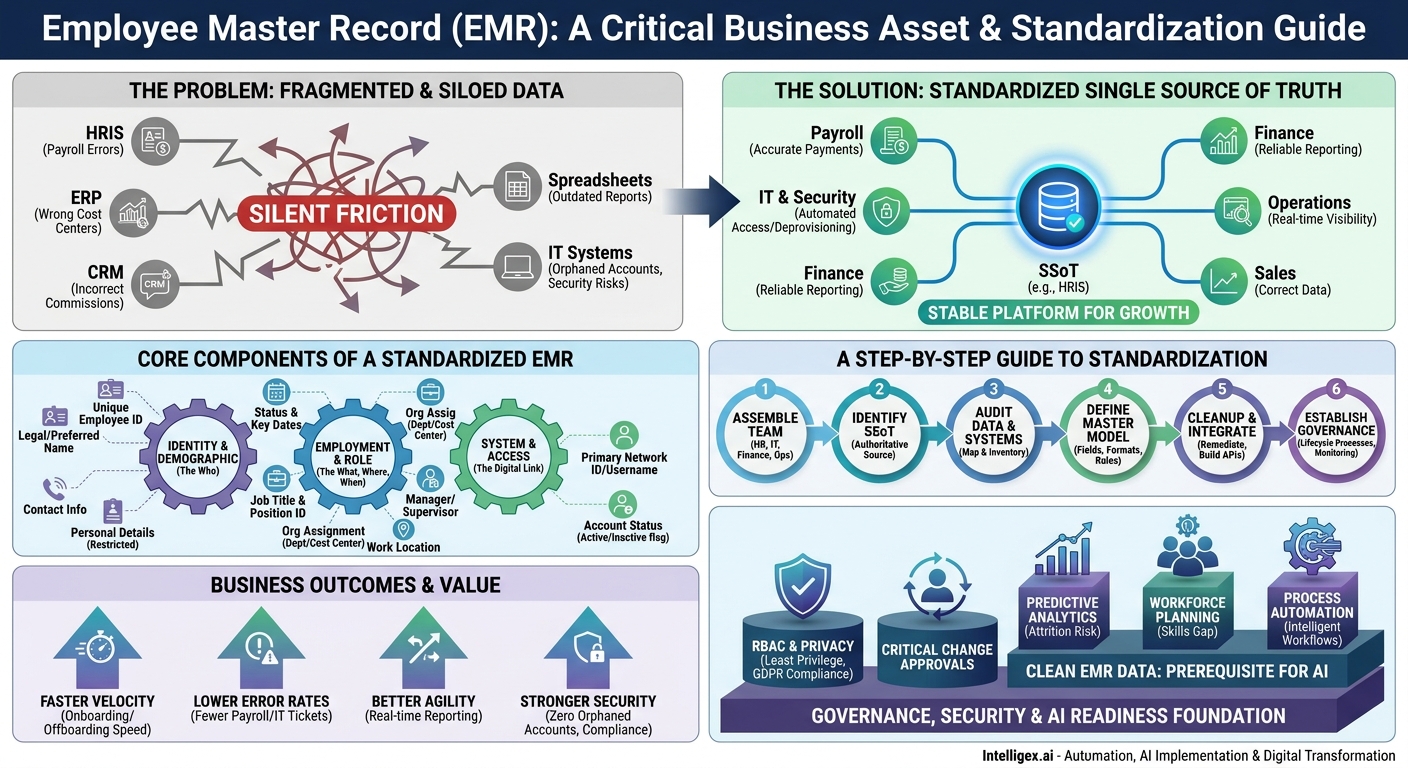
Your employee master record is more than an HR database. It is a critical business asset that fuels everything from payroll and IT provisioning to sales commissions and strategic workforce planning. When this data is fragmented, inconsistent, and siloed across dozens of applications, it creates silent friction that slows down operations, introduces costly errors, and exposes your organization to security risks. The problem is not a lack of data; it is a lack of a single, reliable source of truth.
Standardizing your employee master record is a foundational step in digital transformation. It is the process of defining, consolidating, and governing core employee information to ensure it is accurate, consistent, and accessible to the systems and people who need it. By establishing this clean data core, you create a stable platform for automation, analytics, and scalable growth.
Why a Fragmented Employee Record Cripples Your Business
An inconsistent employee record is not just an administrative headache. It has tangible, negative impacts across every department. The symptoms often appear as isolated problems, but the root cause is almost always a failure to manage employee data as a unified asset.
Consider these common scenarios:
- Finance & Payroll: A manager’s new role is updated in the HRIS but not in the ERP. This leads to incorrect cost center allocations for their team’s expenses and salaries. Manual corrections are required every month, wasting time and increasing the risk of financial misstatements.
- IT & Security: An employee leaves the company, and their account is deactivated in the primary HR system. However, their access to a key sales platform or a financial analytics tool remains active for weeks because the systems are not connected. This “orphaned account” becomes a significant security vulnerability.
- Sales Operations: A sales representative is assigned to a new territory. The change is reflected in the CRM, but the commission calculation tool still pulls old data from a separate spreadsheet. The result is incorrect commission payments, disputes, and demotivated team members.
- Operations & HR: Leadership needs a simple headcount report showing the breakdown of full-time employees versus contractors by department. Compiling this requires manually pulling data from three different systems, reconciling discrepancies in job titles and department names, and spending days to produce a report that is outdated the moment it is finished.
These issues directly impact business performance by degrading speed, increasing costs, and reducing data quality. Onboarding a new hire takes days longer than it should because IT is waiting for manual access requests. Offboarding processes are leaky, creating compliance risks. Business decisions are made using incomplete or inaccurate information. Fixing these problems one by one is a losing battle. The solution is to address the source by standardizing the master record.
The Core Components of a Standardized Employee Master Record
The first step in standardization is to define what data belongs in the master record. The goal is not to centralize every piece of employee information, like performance reviews or training history. Instead, focus on the foundational data elements that are required by multiple systems across the organization to function correctly. We can group these into three essential categories.
1. Identity & Demographic Data
This is the “who” of the employee record. It must be consistent everywhere to avoid duplicate profiles and identity conflicts. Consistency here is non-negotiable.
- Unique Employee ID: The single most important field. This should be a system-generated, non-reusable identifier that follows an employee throughout their entire lifecycle, even if they leave and are rehired. It should never be based on mutable information like an email address or social security number.
- Legal Name & Preferred Name: Both are important for legal documentation (payroll, benefits) and internal communication (email display name, org chart), respectively.
- Contact Information: Includes corporate email, business phone, and optionally, personal contact details for emergency purposes. The corporate email address should be programmatically linked to the Employee ID.
- Personal Details: Date of birth and other sensitive information required for benefits and compliance, which should have highly restricted access.
2. Employment & Role Data
This is the “what, where, and when” of an employee’s position. This data is the backbone of your organizational structure and is vital for financial reporting, resource planning, and access control.
- Employment Status: Defines the relationship, for example, full-time, part-time, contractor, or intern. This is critical for benefits eligibility and financial modeling.
- Key Dates: Hire date, termination date, and any contract end dates. These dates trigger dozens of downstream workflows in IT, payroll, and facilities.
- Job Title & Position ID: The official, standardized job title and a unique ID for the specific position or “seat” in the organization.
- Organizational Assignment: The department, business unit, and cost center the employee belongs to. This data is essential for accurate financial reporting.
- Manager/Supervisor: The Employee ID of the employee’s direct manager. This hierarchical link is what builds your org chart and drives approval workflows.
- Work Location: The physical office, remote location, or hybrid arrangement. This impacts tax calculations, logistics, and security policies.
3. System & Access Data
This category connects the human identity to their digital identity and access rights. While much of this is managed by IT, the master record should be the trigger for key actions.
- Primary Network ID / Username: The employee’s main login for systems like Active Directory or Google Workspace.
- Account Status: A clear flag indicating if the employee’s status is Active, Inactive, or On Leave. This field should be the primary driver for enabling or disabling system access globally.
A Step-by-Step Guide to Standardization
Creating a standardized employee master record is a structured project, not an ad-hoc cleanup. It requires collaboration between HR, IT, and Finance to be successful. Following a clear process prevents rework and ensures the final solution meets the needs of the entire business.
- Assemble a Cross-Functional Team: Your project team must include more than just HR. At a minimum, you need dedicated representatives from HR (the primary data owners), IT (the system integrators and security guardians), and Finance (a key consumer of the data for payroll and reporting). Involving a leader from a major business unit, like Sales or Operations, can provide a valuable customer perspective.
- Identify a Single Source of Truth (SSoT): This is the most critical decision you will make. You must designate one system as the authoritative source for all core employee master data. For most organizations, this is the Human Resources Information System (HRIS) such as Workday or SAP SuccessFactors. All other systems will become subscribers to this master data; they will consume it but not create it. Document this decision and communicate it clearly across the organization.
- Audit Your Data and Systems: Before you can standardize, you must understand the current state. Create a data map that inventories every system that stores or uses employee data. This includes the ERP, CRM, identity management platforms (like Okta), expense management tools, and even significant spreadsheets. For each system, document what employee data it holds, where it gets that data from, and how up-to-date it is.
- Define Your Master Data Model: With your SSoT and system audit complete, your cross-functional team must formally define the master record. This means agreeing on the exact list of fields to be standardized (refer to the components above). For each field, define its format (e.g., date format is YYYY-MM-DD, country codes are ISO 3166-1 alpha-2), acceptable values (for fields like Employment Status), and which system owns the authoritative record.
- Plan and Execute Data Cleanup and Integration: This is where the technical work begins. The project involves two parallel streams. First is data cleanup. You must remediate the inconsistencies discovered during your audit, correcting titles, merging duplicate records, and aligning formats within your chosen SSoT. Second is integration. You will build API-based connections that allow downstream systems to automatically pull data from the SSoT. Avoid point-to-point integrations. Using a central integration platform or middleware can make the architecture more manageable and scalable.
- Establish Ongoing Governance: Standardization is not a one-time project; it is an ongoing discipline. You must establish clear processes for managing the data lifecycle. Document the procedures for onboarding new hires, processing transfers or promotions, and executing terminations. Define who is responsible for entering and approving data changes in the SSoT. Implement monitoring to detect and alert on data synchronization failures.
Connecting the Employee Master to Business Outcomes
A standardized employee master record is not just about clean data; it is a catalyst for tangible business improvements. When data flows seamlessly from a single source of truth, it unlocks efficiencies and provides the visibility needed for better decision-making.
What to Measure
To demonstrate the value of this initiative, focus on metrics that resonate with business leaders. Instead of just reporting on “data quality,” track the operational improvements that result.
- Employee Lifecycle Velocity: Measure the time it takes to fully provision a new hire with all necessary system access. Also, track the time-to-deprovision, which is the time from when a termination is entered in the SSoT to when all critical system access is revoked. Improvements here directly enhance both productivity and security.
- Operational Error Rate: Monitor the number of monthly IT help desk tickets related to access problems or incorrect user data. In Finance, track the number and value of payroll corrections required each cycle. A reduction in these metrics signals a direct cost saving.
- Reporting and Analytics Agility: Measure the time it takes for your HR and Finance teams to produce accurate, cross-departmental headcount and organizational reports. Moving from days of manual reconciliation to near real-time, automated reporting is a significant win for strategic planning.
- Security and Compliance Posture: Track the percentage of active user accounts in key applications that are successfully tied to an active employee in your SSoT. The goal is to drive the number of “orphaned accounts” to zero, reducing your security risk and simplifying compliance audits.
By focusing on these outcomes, you can clearly articulate the business value. Standardization moves from being an “IT project” to a strategic enabler that delivers speed, reduces cost, and improves visibility across the enterprise.
Governance, Security, and AI Readiness
Employee data is sensitive, and centralizing it requires a robust governance and security framework. This is not just about compliance; it is about building trust and ensuring the data is used responsibly. Furthermore, a well-governed master record is a prerequisite for leveraging more advanced technologies like artificial intelligence.
Access Control and Privacy
A standardized record does not mean everyone can see everything. Implement strict Role-Based Access Control (RBAC) to enforce the principle of least privilege. A hiring manager should be able to see their team’s job titles and departments, but not their personal contact information or compensation details. Finance and HR will have more privileged access, but even their activities should be logged and audited. Ensure your data handling processes are compliant with regulations like GDPR and CCPA, which means understanding data residency requirements and honoring employee rights to their data. You can learn more about general obligations on the official GDPR portal.
Human-in-the-Loop for Critical Changes
While the goal is to automate data synchronization, critical changes should always have a human checkpoint. A workflow that automatically deprovisions an employee upon termination is efficient, but the initial termination event in the SSoT must be entered and approved by an authorized person, such as an HR business partner or a senior manager. This human-in-the-loop approach prevents a simple data entry mistake from causing a major operational disruption.
The Foundation for AI
You cannot build a house on a shaky foundation. In the same way, you cannot build reliable AI models on fragmented, inconsistent data. A clean employee master record is a fundamental prerequisite for trustworthy AI and machine learning applications in HR and operations. With a standardized dataset, you can begin to explore:
- Predictive Analytics: Building models to identify factors contributing to employee attrition.
- Workforce Planning: Analyzing skills data against organizational structure to identify future hiring needs.
- Process Automation: Creating intelligent workflows that can suggest system access or equipment needs based on an employee’s standardized role and department.
Without a standardized EMR, these initiatives are doomed to fail, producing inaccurate insights and flawed automations. By getting the fundamentals right today, you prepare your organization to safely and effectively leverage these advanced capabilities tomorrow.
Your Next Steps: Building the Foundation
Starting a master data project can feel daunting, but you can achieve significant momentum by taking a phased, pragmatic approach. The goal is to build a solid foundation that you can expand upon over time. Focus on making incremental progress rather than attempting a massive, multi-year overhaul from day one.
Use the following checklist to plan your immediate actions and build a roadmap for the coming year.
Short-Term Plan (This Quarter)
- Identify Key Stakeholders: Schedule an initial meeting with leaders from HR, IT, and Finance. Present the business case for standardization by focusing on one or two high-impact pain points, such as slow onboarding or frequent payroll errors.
- Conduct a High-Level Systems Audit: Create a simple inventory of the top 5-10 systems that contain employee data. Don’t aim for perfection; the goal is to quickly understand the scope of the problem.
- Draft a Business Case: Document the problems, the proposed solution (SSoT, governance), and the expected business outcomes (e.g., “reduce new hire provisioning time by 50%”). Secure executive sponsorship for a formal discovery and planning phase.
Long-Term Roadmap (Next 6-12 Months)
- Formalize the SSoT Decision: Complete a thorough evaluation and formally designate your HRIS or another system as the single source of truth for employee master data.
- Develop the Master Data Model and Governance Rules: Run workshops with your cross-functional team to define the core data elements, formats, and ownership policies.
- Begin a Phased Rollout: Do not try to integrate everything at once. Start with the most critical integrations, such as connecting your SSoT to your primary identity management system (e.g., Active Directory). Use the success of this first phase to build momentum for connecting other key applications like your ERP and CRM.
By treating your employee master record as the strategic asset it is, you create a ripple effect of efficiency, visibility, and security that benefits every corner of your organization.
Your Next Read:
Category:
Get a FREE
Proof of Concept
& Consultation
No Cost, No Commitment!